Last updated: 4 September 2026
1Introduction
Quick Answer: A 360 booth is for guest participation at volume. A GlamBot is for a small number of hero shots with controlled lighting. The deciding question is whether your event has a red carpet moment.
These two formats look almost identical in a brochure. A robotic arm, a camera, slow motion, a vertical clip at the end.
They behave completely differently at an event, and the gap has nothing to do with the hardware.
A 360 hands control to the guest. They step on, they do something, the machine flatters it. Everyone can have a turn and most people will.
A GlamBot keeps control with an operator. It runs a designed camera move through a lit space, and the subject is directed. It produces a small number of genuinely cinematic clips rather than a large number of fun ones.
This guide compares them on the things that actually decide a booking: who participates, what the room has to provide, what you end up with, and where each one fails.
Watch: what a slow motion arm produces
A short showcase of cinematic slow motion booth footage. Note how much of the effect comes from the lighting and the controlled background rather than from the arm itself.
Source: The Slow Motion Booth
2The real difference: who is in control
Quick Answer: On a 360 the guest is the author of the moment. On a GlamBot the operator is, and the guest is the subject of somebody else’s shot.
Everything else in this comparison follows from that one sentence.
Because the guest authors a 360 clip, the format is forgiving. Anything they do is fine, the machine makes it look considered, and nobody feels judged.
Because an operator authors a GlamBot clip, the format is demanding. It needs a subject who is willing to be directed and who looks the part when the lighting hits them.
That changes who volunteers. On a 360 platform, a group of colleagues will push each other on and laugh through it. In front of a GlamBot, the same group will send one person forward and watch.
Neither response is a failure. They are simply different events, and booking the wrong one produces a very expensive machine with nobody in front of it, which is the same failure our guide to corporate booth ideas describes for props.
3Side by side on the things that matter
Quick Answer: A 360 wins on throughput, accessibility and cost. A GlamBot wins on image quality, brand polish and the strength of a single clip.
| Dimension | 360 booth | GlamBot style arm |
|---|---|---|
| Guests served | High, groups at a time | Low, individuals or pairs |
| Who takes part | Almost everybody | The confident and the dressed up |
| Room requirement | Clear circle and headroom | Controlled backdrop and lighting |
| Output character | Fun, energetic, many clips | Polished, cinematic, few clips |
| Crew needed | Attendant and queue manager | Operator, often with a lighting hand |
| Typical cost position | Mid range | Premium |
General comparison of the two formats rather than measured ShutterPop data. Individual setups vary.
The row that decides most bookings is the second one. If you need broad participation, the answer is already in the table.
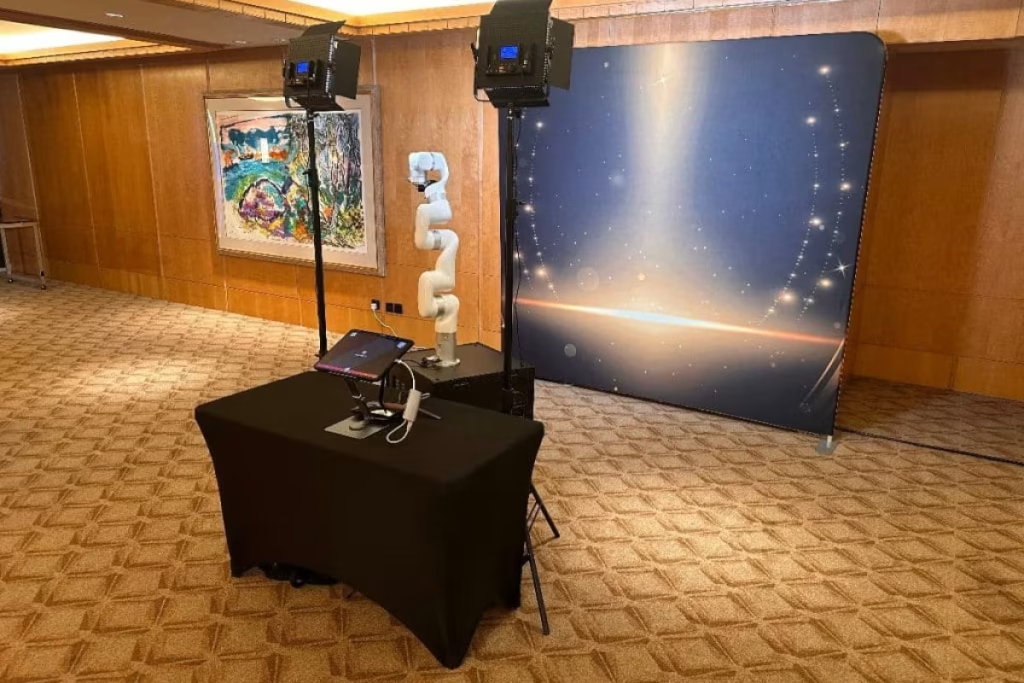
4A GlamBot is a small film set
Quick Answer: The cinematic look comes from lighting and a controlled background, not from the arm. Put the same arm in a bright hotel foyer and the footage looks ordinary.
This is the point most buyers discover after signing, and it is the single most useful thing to understand before you compare prices.
Watch any impressive slow motion booth clip and pay attention to the background. It is dark, or clean, or deliberately lit. It is never a corridor with a fire exit sign in it.
The arm produces the movement. Everything that makes the movement look expensive is light: a key light on the face, some separation behind the subject, and control over what else is in frame.
So a GlamBot needs floor area you might not have budgeted for. Not for the arm, but for the backdrop, the lighting stands and the space to keep the general public out of shot.
It also needs a degree of darkness. A ballroom foyer at two in the afternoon with glass along one wall is the hardest environment this format can be asked to work in.
5The entrance moment test
Quick Answer: If your event has a moment where guests arrive dressed and expecting to be photographed, a GlamBot fits. If it does not, the arm has nothing to work with.
Here is a single question that settles the choice faster than any feature list.
Does your event have an entrance? Not a door, but a moment where people arrive looking their best and understand that being photographed is part of it.
Award nights, gala dinners, brand launches and film-style premieres all have one. So does an annual dinner with a strong dress code, which our guide to annual dinner booths argues is the most underused asset at that event.
A family day does not have one. Neither does a mall roadshow, a trade show aisle or a casual office party, and putting a cinematic arm at any of them wastes the format.
If the answer is no, a 360 is almost always the better purchase, because it creates its own moment instead of relying on one the event already has.
This matters more in Malaysia than the imported advice suggests. A great many company events here are run by small and medium businesses, and the Department of Statistics Malaysia counted 8.09 million people employed by MSMEs in 2025. Those events tend to be warm, informal and short on red carpet, which points firmly at the participatory format.
6Throughput and the queue problem
Quick Answer: Both formats are slow compared with a print booth, and a GlamBot is the slower of the two because each clip is directed. Match the format to your guest count.
Throughput is where good intentions meet arithmetic, and it is the most common planning error in this category.
A 360 handles groups, which is its saving grace. Five friends occupy one session, so a two hundred guest event is not two hundred turns.
A GlamBot handles one or two people at a time, and the operator often wants a second take. That is the right instinct for quality and it halves the number of guests served.
So a cinematic arm at a large event needs framing honestly for the client. It is not there to serve everybody, it is there to produce a set of strong clips.
If broad coverage matters, the usual answer is a cinematic arm for a defined window during arrivals and a faster format for the rest of the night, which is the same logic our guide to booth hours applies to programme timing.
7What each one is like to stand in front of
Quick Answer: A 360 is social and noisy with an audience cheering. A cinematic arm is quiet and exposing, closer to a short screen test than a party activity.
Guest experience is not a soft consideration here. It determines whether the machine is used.
On a 360 platform the guest is surrounded by people they know, the mood is loud, and the whole thing is over before anyone gets self-conscious.
In front of a cinematic arm the guest is alone in a pool of light while a stranger directs them. Some people love it and become the best clip of the night.
Others find it genuinely uncomfortable, and a good operator can tell within seconds which is which. That skill is most of what you are paying for.
Consider your guest list honestly. A room of marketing people at a launch will queue for it. A room of engineers at a family-heavy dinner may not, and a booth nobody uses is worse than a cheaper one that everybody does.
8What you can do with the footage afterwards
Quick Answer: A 360 gives you volume for guests to post. A cinematic arm gives you a small number of clips clean enough to use in the brand’s own advertising.
For a corporate client this is often the decider, and it is rarely discussed at the quoting stage.
360 clips are guest content. They are shared widely, they carry your branding into feeds, and they are excellent at reach. What they are not is broadcast quality material for a campaign.
That reach is not a small consolation prize. With 98.3 per cent of individuals online in 2025 according to the same department, a hundred guests posting their own clips will out-distribute one polished film almost every time. The polished film simply does something the guest clips cannot, which is represent the brand in its own voice.
Cinematic arm footage can be. Shot against a controlled background with proper lighting, individual clips can sit in a brand’s own channels without looking like event coverage.
That has a licensing consequence. If you intend to use a guest’s image in advertising, you need permission that says so, and Malaysia’s Personal Data Protection Department has issued circulars under the amended framework that make handling this properly worthwhile.
The practical version is a short, plainly worded notice at the booth and a record of who agreed, an approach our guide to consent at events sets out.
9Can you have both?
Quick Answer: Yes, and it works when they run at different times rather than side by side. A cinematic arm during arrivals and a 360 later in the evening uses each format where it is strongest.
Running both simultaneously is usually a waste, because they compete for the same guests and the same attention.
Sequencing them is different and often excellent. The arm covers arrivals while guests are freshly dressed and the room is not yet loud.
The 360 then opens after dinner, when the mood has loosened and people want to do something together rather than be photographed individually.
This only makes sense above a certain scale. Below roughly a hundred and fifty guests, two premium formats will leave one of them idle for most of the night.
Below that threshold, pick one and spend the difference on hours, crew or a print booth so that guests leave holding something, a trade-off our guide to print against digital examines.
10Choosing in four questions
Quick Answer: Ask about the entrance moment, the guest count, the lighting you can control, and whether the footage needs to be brand usable.
Four questions cover it, and they can be answered before you speak to a supplier.
- Is there an entrance moment where guests arrive dressed and expecting a camera?
- How many guests need to feel included, rather than merely entertained?
- Can you control the light and the background in the space available?
- Does the footage need to be usable by the brand afterwards, not just by guests?
Two or more answers pointing towards control, polish and brand usage means a cinematic arm. Two or more pointing towards inclusion and volume means a 360.
Not sure which one your event needs?
Describe the room, the guest count and the moment you want captured, and we will tell you which format earns its place — see our GlamBot video booth →
11Conclusion
Quick Answer: Choose a 360 when you want most of the room to take part, and a cinematic arm when you want a small number of clips that look like advertising.
The GlamBot against 360 booth question is usually framed as a technology comparison and it is really a question about your event.
If the evening has a moment where people arrive at their best, a cinematic arm turns that moment into footage nothing else at the event will match.
If it does not, or if what you want is a room full of people enjoying themselves, the 360 does more for less and reaches far more of your guest list.
For the mechanics of the participatory option, our guide to how a 360 booth works covers the session in detail, and for the ideas side of cinematic capture see our guide to slow motion booth ideas.
12Frequently asked questions
What is the difference between a GlamBot and a 360 booth?
A 360 booth orbits a group standing on a platform and the guest decides what happens. A GlamBot style arm runs a directed camera move on one or two people against controlled lighting, and an operator shapes the shot.
Which one do guests enjoy more?
More guests take part in a 360, because it is social, forgiving and quick. A cinematic arm produces a stronger single clip but appeals mainly to confident guests who are dressed for the occasion.
Is a GlamBot worth the extra cost?
It is when the event has a genuine entrance moment and you can control the lighting and background. Without those two conditions the premium disappears and the footage looks much like any other slow motion clip.
Can you run both at the same event?
Yes, and it works best when they run at different times rather than together. Use the cinematic arm during arrivals and open the 360 later in the evening, though this only pays off above roughly a hundred and fifty guests.
Which format handles more guests per hour?
A 360 booth, by a wide margin, because it films groups rather than individuals. A cinematic arm often takes a second attempt for quality, which reduces the number of guests served further.
Deciding between a GlamBot and a 360?
Tell us the venue, the guest count and whether the event has an arrivals moment. We will recommend one, and say clearly why the other would underperform.