Last updated: 4 September 2026
1Introduction
Quick Answer: Plan an annual dinner photo booth around arrival and the post-awards window, capture the themed outfits full length, and never run it against the lucky draw.
The company annual dinner is the one night a year when a Malaysian workforce dresses up on purpose.
Departments coordinate outfits weeks in advance. People buy something specific for the theme. Then the evening runs on a tight programme, the photographs are three group shots taken from a stage, and none of that effort is recorded.
A booth solves a real problem here, but only if it is planned against the programme rather than dropped into a corner for four hours.
These events are near-universal across Malaysian business, from listed groups down through the MSMEs that employed 8.09 million people in 2025 according to the Department of Statistics Malaysia, and the constraints are remarkably consistent between them.
Watch: planning the evening around the programme
A step-by-step look at planning a formal dinner event. The sequencing logic is the part that matters here, because it is what dictates when a booth can realistically run.
Source: vFairs
2The run of show is the real constraint
Quick Answer: Guests are seated and captive for most of the evening. The booth has roughly two usable windows: arrival before the first course, and the stretch after the awards or performances.
A Malaysian annual dinner is a seated banquet with a programme, not a mingling reception. That single fact invalidates most imported booth advice.
Once guests are seated, courses arrive on a schedule, speeches run, awards are presented and the lucky draw looms. Nobody wanders off during any of it, and a booth running through the awards will stand empty while the attendant watches a stage.
| Segment | Guests are | Booth demand |
|---|---|---|
| Registration and arrival | Standing, free | Very high |
| Opening and first courses | Seated | Almost none |
| Speeches and awards | Seated, watching | None |
| After the awards | Moving between tables | High |
| Lucky draw | Seated, unmovable | None at all |
| Closing and departure | Leaving in waves | Brief spike |
Illustrative planning model rather than measured ShutterPop booking data. Programmes vary, but the seated segments dominate in almost all of them.
Read down the demand column and the booking decision writes itself. Buy the windows, not the evening.
3The dress code is the asset nobody uses
Quick Answer: Staff invest real money and effort in the annual dinner theme, and nothing else at the event photographs it properly. Capture full length rather than head and shoulders.
Almost every Malaysian annual dinner has a dress code, and it is taken seriously. Departments coordinate, budgets get spent, and there is quiet competition about who committed hardest.
Then the whole thing is photographed from the chest up, which throws away the part people actually worked on.
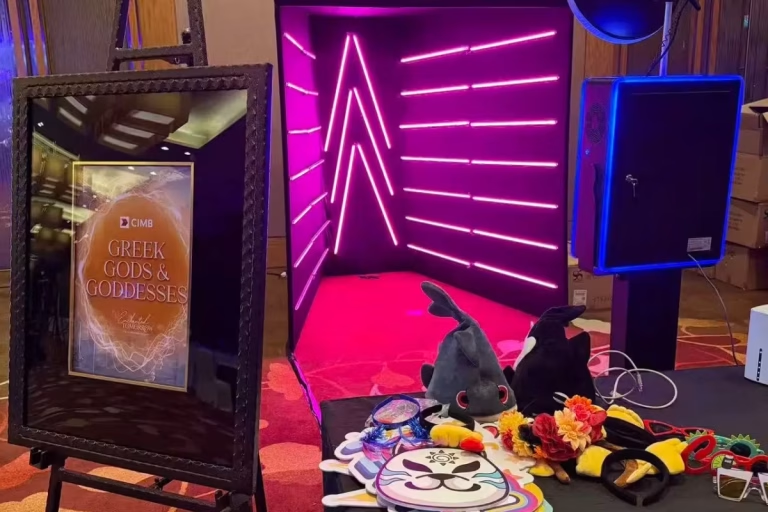
That is the single strongest annual dinner booth idea, and it is a specification rather than a concept: choose a format that frames the whole person. A magic mirror or an open booth with a taller backdrop shows shoes, hemlines and the full outfit, and the resulting photographs are kept far longer.
There is a social benefit to it as well, and it connects to why corporate booths often stand idle. Nobody has to invent a pose when they are being photographed for what they are wearing. The outfit is the reason to step forward, which gives even reserved staff a perfectly respectable excuse to take part in front of their director.
Two supporting decisions follow. Give the queue enough depth for the camera to step back, and light the lower half of the frame properly, because a well-lit face above dark trousers is exactly the photograph that wastes the theme.
A word on themed colour. Pantone’s Colour of the Year for 2026 is PANTONE 11-4201 Cloud Dancer, a soft white, and a white dress code against a white backdrop produces guests who disappear into the wall. If the theme is pale, the backdrop must not be.
4Which format suits the evening
Quick Answer: Instant print for keepsakes and table groups, a mirror or open booth for full-length outfit shots, and a mosaic wall when leadership wants something on stage at the end.
Different formats solve different parts of the same evening, and a large dinner can justify two stations.
Instant print is the workhorse. A physical photograph handed over during arrival is taken back to the table, shown around and kept, and it costs very little per guest.
Full-length formats do the theme justice, as above. They are slower per session, which is fine in a two-window plan and a problem if you expected to serve six hundred people in forty minutes.
A mosaic wall earns its place differently. It gives the committee a visible result that fills through the evening and can be shown from the stage before the lucky draw, which is a genuinely good use of a segment where nothing else is happening.
A 360 platform is the risky choice at a formal dinner. It photographs beautifully and it is slow, loud in an unhelpful way during speeches, and demands clear floor space a ballroom rarely has spare, as our guide to booth space requirements explains.
5Where it goes in the ballroom
Quick Answer: Near the registration table for the arrival window, with a queue that runs along a wall rather than across the route to the tables.
The best position for an annual dinner booth is decided by the arrival window, because that is when demand peaks.
Guests arrive, register, collect a table number and then have fifteen to thirty unstructured minutes. A booth within sight of the registration desk catches all of that with no promotion at all.
Inside the hall the usual corners compete with the cake table, the sponsor display and the gift table. Ask for the corner in writing when the venue is confirmed, because whoever asks first gets the usable one.
Two things to avoid. Do not place a reflective format facing the stage LED wall, which throws shifting colour across the glass all evening. And do not place the booth where its queue crosses the service route, or the banquet manager will move it during dinner.
Seasonality matters more than people expect. Annual dinner season runs through the northeast monsoon that the Malaysian Meteorological Department describes as running from December to March, so poolside and garden positions need a covered fallback with power, agreed in advance rather than found in a hurry.
6Working with the emcee
Quick Answer: One scripted mention at the right moment fills the booth for twenty minutes. An unscripted mention during the awards empties the hall at the worst time.
The emcee controls attention, and a booth that has not been written into the script is invisible to two-thirds of the room.
Ask for two lines. One at the start of the arrival window telling guests where the booth is, and one immediately after the awards inviting tables to go across while the room resets.
Timing is the whole game. A mention during the meal sends people up while food is being served, which annoys the banquet team and produces a queue that dissolves when the next course lands.
If you are running a mosaic wall, give the emcee a third line to reveal it before the lucky draw. That converts a filling wall into a shared moment and gives the committee a photograph worth circulating on Monday.
Brief the attendant on the script too. Somebody at the booth who knows the awards are about to start can politely hold the queue rather than sending guests back to their tables mid-session.
7Throughput for a large headcount
Quick Answer: Work backwards from the window. If four hundred people have forty minutes, one booth cannot serve them individually, so serve them as tables or add a second station.
This is where annual dinners differ most sharply from weddings: the whole company is released at the same moment.
A single station handles a group every minute or two once prints are included. Across a forty-minute window that is perhaps twenty-five to thirty sessions, which is fine for tables and hopeless for individuals.
So decide the unit deliberately. Ten people per session serves the room; one person per session serves the first thirty people and disappoints the rest.
Print quantity needs the same arithmetic. A table of ten photographed together will ask for several copies, not one, so a print allowance calculated from session count rather than headcount runs out during the busiest twenty minutes of the evening. Agree the cap in advance and decide what happens when it is reached, because the alternative is an attendant improvising a rationing policy in front of a queue.
Two levers help. A second booth roughly doubles capacity for less than double the cost, and switching off slow features shortens each session, which our guide to booth hours and throughput works through in detail.
Digital delivery relieves the rest of the pressure. With 99.6 per cent of individuals using a mobile phone in the Department of Statistics Malaysia’s 2025 survey, everyone photographed can receive their file even if the printer never catches up.
8What the company keeps afterwards
Quick Answer: A folder of department group photographs, a set of long-service portraits and a handful of usable images for recruitment posts, all delivered within a few days.
The booth output usually outlives the event photographer’s gallery, because it contains the pictures people are actually in.
Ask for the files organised rather than dumped. Sorted by time, with the table number or department in the filename where the layout allows it, turns a folder into something internal communications can use.
Long-service and award recipients deserve a deliberate capture. A portrait taken at the booth immediately after the presentation, while the recipient still has the certificate, beats a stage photograph taken from thirty metres away.
If any of it will be published externally, say so on a sign at the booth in plain language, and keep the wording separate from the print artwork. The Personal Data Protection Department has issued circulars under the amended framework, and anything collected alongside the photographs falls within it.
9How the budget usually works
Quick Answer: The booth is a small line beside the venue and the food, and it survives review when it is framed as replacing the goodie bag or the group photographer rather than adding entertainment.
An annual dinner budget is dominated by the per-head banquet price. Everything else fights over what is left.
That is why the framing matters. A booth presented as fun sits beside the band and the decorations, all of which are cut first. A booth presented as the item that replaces a token gift, or supplies the department photographs the committee would otherwise chase, survives.
Sponsorship is the other route, and it is common. Departments, suppliers or a business partner will often fund the booth in exchange for their mark on the print, which turns the line into a shared cost.
Watch for the hidden extras rather than the headline rate: travel outside the free radius, idle time between windows, and print quantities that run out an hour in.
If sponsors are involved, the artwork needs a hierarchy rather than a row of equal logos, which our guide to print branding covers.
10A timeline for the committee
Quick Answer: Book once the venue and date are fixed, confirm the theme and artwork a fortnight out, and lock the run of show with the emcee in the final week.
Annual dinner planning is committee work, so a short sequence prevents most of the usual scrambling.
- On venue confirmation. Reserve the corner and ask about the setup window and the nearest socket.
- Once the theme is set. Choose the format, because a dress-up theme argues for full-length capture.
- Two weeks out. Send logo files and exact wording; approve the proof three days before.
- Final week. Agree the two booth windows and the emcee lines against the run of show.
- On the day. Confirm the setup time against room release and check the marked floor plan.
Only the fourth item is unusual, and it is the one that decides whether the booth is busy or ignored.
Annual dinner coming up?
Send us the headcount, the theme and the draft run of show and we will tell you which windows to cover — see our corporate booth range →
11Conclusion
Quick Answer: Cover arrival and the post-awards window, capture the theme full length, work as tables at scale, and get two lines from the emcee.
The best annual dinner photo booth ideas are structural rather than decorative. They come from reading the programme and buying the two windows that are actually available.
After that, one decision does most of the remaining work: photograph the whole person, because the dress code is the part of the evening staff invested in and the part nothing else records.
Everything else follows. Tables as the unit at scale, a corner reserved in writing, artwork approved early, and files that arrive organised.
If the same committee also runs the family day, the constraints invert completely, which our guide to family day booths covers.
12Frequently asked questions
How many hours should a photo booth run at an annual dinner?
Usually two to three hours, but placed rather than spread. Cover arrival and the period after the awards, and skip the seated segments where nobody can leave their table.
What is the best photo booth for a company annual dinner?
Instant print for volume and keepsakes, and a full-length format such as a magic mirror or open booth if there is a dress code worth photographing. Large events often run both.
How do you get staff to actually use the booth?
Invite them by table rather than individually, and get the emcee to mention it twice at the right moments. Group framing removes the awkwardness of performing in front of colleagues.
Can the booth be sponsored by a supplier or department?
Yes, and it is common. The sponsor’s mark goes on the print overlay and the sharing page, and it works best with a clear hierarchy rather than a row of equally sized logos.
Should the photo booth run during the lucky draw?
No. Nobody leaves their seat during a lucky draw, so those minutes are wasted booth hours. Use that segment to reveal a mosaic wall from the stage instead.
Planning this year’s annual dinner?
Send us the headcount, the venue and the theme. We will tell you which windows to book, which format suits the dress code, and what to ask the hotel for.