Last updated: 4 September 2026
1Introduction
Quick Answer: Both put a guest in front of a chosen background. A green screen does it physically with a coloured cloth and even lighting. An AI background photo booth does it in software, with no cloth at all.
Suppliers usually present this as a straight upgrade, with green screen as the old way and AI as the new one. That is not what the choice actually looks like.
A green screen is fussy, space hungry and completely predictable. Once it is lit correctly, every guest gets the same clean result all night.
An AI background booth fits anywhere, sets up in minutes and produces a slightly different quality of cut for every guest depending on their hair, their clothes and what is behind them.
So the decision is a trade between space and consistency, and the right answer changes with the venue and with what the client needs the images for.
Watch: the two methods compared side by side
A direct comparison of green screen keying and AI background removal on the same footage. The edge differences it shows are exactly the ones that matter in a booth print.
Source: Skyglass
2What each method actually does
Quick Answer: A green screen removes one known colour, which is a simple and reliable rule. AI segmentation guesses where the person ends, which works well in the middle and less well at the edges.
The mechanics explain every practical difference that follows.
Keying a green screen is a colour decision. The software removes a narrow band of green and keeps everything else, so if the cloth is evenly lit the result is the same for every guest.
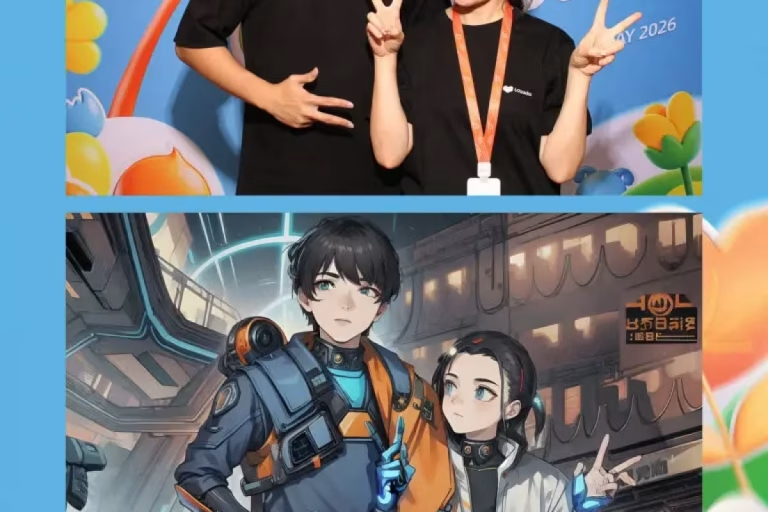
AI segmentation makes a judgement instead. It works out which pixels belong to a person and which do not, without needing any particular colour behind them.
That judgement is very good on a torso and much harder on loose hair, a raised hand, a sheer scarf or a pair of glasses, because those are the places where person and background genuinely blend.
Neither approach is cheating. They are answers to different problems, and the second one only became practical recently because it needs real processing power in the booth.
3Space is usually what decides it
Quick Answer: A green screen needs a wide cloth, distance between the guest and the cloth, and its own lighting. In a crowded ballroom or a mall concourse that space often does not exist.
This is the reason AI booths spread so quickly in Malaysia, and it is a floor plan argument rather than a technical one.
A green screen needs a backdrop wide enough for a group, a metre or so between guest and cloth so the green does not spill onto shoulders, and lights aimed at the cloth separately from the lights on the guest.
Add the guest, the camera and the queue and you are asking a venue for a meaningful piece of floor. Hotel ballrooms set for a full banquet rarely have it in the place you want the booth.
An AI booth needs the guest, the camera and enough room to stand. It goes in a corner, a corridor or a mall lot where a green screen simply will not fit.
Our guide to booth space requirements sets out the floor areas involved, and the gap between the two formats is the single largest in the range.
4Where AI background removal goes wrong
Quick Answer: Fine hair, dark hair against a dark room, sheer fabric, held objects and several people at different distances. All of them are common at a Malaysian evening event.
The failures are specific and predictable enough that you can test for them in advance.
Hair is the first. Loose strands against a busy background are the hardest thing to cut, and the software either keeps a halo of the room or trims the outline into a helmet shape.
Contrast is the second, and it is the one that matters most here. Dark hair, a black tudung or a dark suit against a dimly lit ballroom gives the software very little to separate, and that describes a large share of Malaysian evening events.
Then come the awkward cases. A hand raised in front of the body, a drink held out towards the camera, a sheer shawl or a bouquet all sit in the gap between person and not person.
Groups add depth. Two people at different distances from the camera can be cut differently in the same frame, which is visible immediately when one of them has a clean edge and the other does not.
5Where green screen goes wrong
Quick Answer: Uneven lighting, creases in the cloth, guests wearing green, and green light bouncing back onto skin and shoulders. All fixable, all requiring an attendant who knows what they are doing.
The older method has its own list, and it is a list of setup errors rather than surprises.
Uneven lighting is the main one. A cloth that is bright in the middle and dark at the edges will not key cleanly, and the result is ragged outlines in exactly the corners of the frame where groups stand.
Creases do the same thing at a smaller scale, which is why a cloth that has been folded in a case all week needs steaming or stretching before the event.
Spill is the subtle one. Green light bounces off the cloth onto a guest’s shoulders and hair, and the key then eats into them, leaving a faint outline that looks like a cheap cutout.
And then there is the guest in a green baju or a green company polo shirt, who becomes partly invisible. It happens at every corporate event where green is a brand colour, and there is no fix on the day.
6Consistency is the reason to choose one over the other
Quick Answer: If every image has to look the same, green screen wins. If the images are individual keepsakes, the variation in AI cutting matters far less.
| Requirement | Green screen | AI background |
|---|---|---|
| Tight or crowded venue | Often impossible | Fits almost anywhere |
| Two hundred consistent brand images | Stronger | Varies guest to guest |
| Setup time under thirty minutes | Difficult | Straightforward |
| Clean edges on loose hair | Reliable when lit well | The weak point |
| Outdoor or daylight events | Hard to light evenly | Usually better |
Illustrative planning model rather than measured ShutterPop data. Results depend heavily on the specific venue, lighting and guest clothing.
The middle row is the one that decides most corporate bookings. A campaign that will publish a grid of guest portraits needs them to match, and a method that cuts each guest slightly differently makes that grid look untidy.
A wedding or a family day has the opposite requirement. Each guest keeps their own picture and nobody ever sees two of them side by side, so a small variation in the edge quality costs nothing.
That framing is more useful than asking which is better. Ask what the images are for, and the answer follows, which is the same discipline our guide to measuring activation results applies to the whole booking.
7Test with the guests you will actually have
Quick Answer: A demo done in a bright office with one person in a white shirt proves nothing. Ask for a test in conditions like your event, with people dressed like your guests.
Every supplier demo is run in the best possible conditions, and that is where most disappointment comes from.
The test that means something uses the lighting level of your venue, guests in the clothing your guests will wear, and at least one person with dark hair against a dark background.
Include somebody in a headscarf and somebody wearing glasses. Both are edge cases for segmentation and both will be at your event.
Ask to see the raw output rather than a chosen example. One good picture proves the method can work, and you need to know how it behaves on average.
If the supplier will not test, that is an answer too, and our guide to what to watch for when hiring covers the rest of that conversation.
8The backdrop guests can see
Quick Answer: Neither method gives the room anything to look at. A physical backdrop is what makes the booth visible across a hall and what everyone else photographs on their phones.
This is the point that gets lost in a technical comparison, and it matters more than either method does.
A composited background exists only in the final image. Everybody standing in the hall sees a guest in front of a green cloth, or in front of whatever happens to be behind the booth.
That affects the booth’s pull. A well designed physical backdrop recruits people from across a room, and a bare corner recruits nobody.
It also affects the phone photographs guests take of each other while queueing, which are often more numerous than the booth prints themselves.
So a common answer is both: a real backdrop that looks good in the room, with digital scenes offered as an extra rather than as the only option. The reasoning is the same one our guide to choosing a backdrop works through.
9Choosing the scenes you drop guests into
Quick Answer: A flatly lit guest cut into a photograph of a sunlit street looks wrong however clean the edge is. Graphic and stylised backgrounds forgive far more than photographic ones.
The background library is chosen last and causes half the complaints, whichever method produced the cutout.
A photographic scene carries its own light. Bright sun from the left, deep shadows, a particular colour cast, none of which match a guest lit evenly by a booth light a metre away.
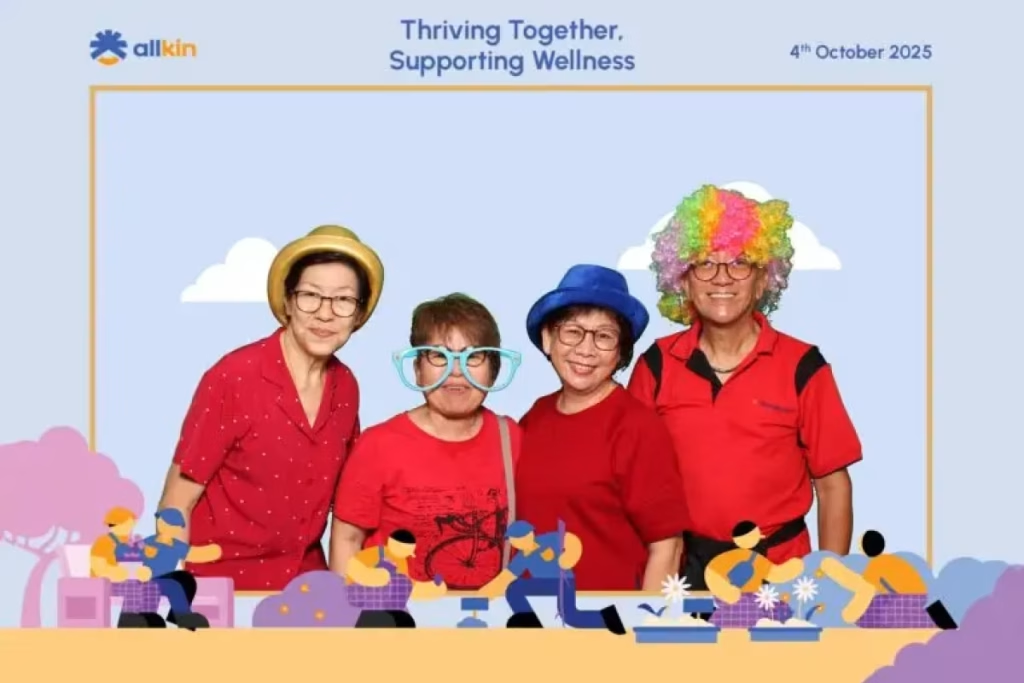
Graphic backgrounds have no such problem. Colour fields, patterns, illustrated scenes and softly blurred settings all accept a flatly lit person without argument.
Where a photographic scene is required, choose one that is softly lit or slightly out of focus, and ask the supplier to add a light on the guest from the same side as the light in the picture.
For brand work, leave deliberate empty space in the scene for a logo or a campaign line rather than laying type over a busy image, which is the same layout point our guide to branded prints and frames makes.
10A short way to decide
Quick Answer: Five questions that settle it in a couple of minutes, in the order they usually matter.
Work down the list and stop at the first one that gives you a clear answer.
- Can the venue give you the floor space and lighting positions? If not, choose AI.
- Do the images need to match each other? If yes, lean to green screen.
- How dark is the room and how dark are the outfits? Dark on dark favours green screen.
- Is the event outdoors or in daylight? That usually favours AI.
- Have you seen a test in your conditions? Until you have, the rest is guesswork.
Most Malaysian indoor events end up choosing AI on the first question alone, and then the third question decides how the booth should be lit rather than which method to use.
One more practical note. If you choose AI and the room is dark, adding a light on the guest fixes most of the edge problems at once, because it separates them from what is behind them.
Not sure which one suits your venue?
Send us the venue and the event lighting and we will tell you honestly which method will give you cleaner results on the day. see our AI booths →
11Conclusion
Quick Answer: Choose by space and by how consistent the images must be. Test in your own lighting, and keep a physical backdrop either way.
An AI background photo booth and a green screen booth are solving the same problem with opposite trade offs, and neither one is simply better.
Green screen gives you a result you can predict, and asks for space, time and even lighting in return. AI gives you a booth that fits anywhere, and asks you to accept some variation at the edges.
In most Malaysian venues space decides it, and the remaining work is lighting the guest well enough that the software has something clear to cut around.
For the wider AI range see our guide to AI photo booths in Malaysia, and for what happens to guest images either way, our guide to AI booth privacy. The full range is on the ShutterPop site.
12Frequently asked questions
What is an AI background photo booth?
A booth that separates the guest from whatever is behind them in software and places them on a chosen background, without needing a coloured cloth. It sets up in a much smaller space than a green screen.
Is AI background removal better than a green screen?
Not automatically. AI fits into far tighter spaces and sets up faster, while a green screen gives a more consistent cut from guest to guest once it is lit correctly. The venue and the use of the images decide it.
Why do some AI cutouts look rough around the hair?
Because the software has to judge where the person ends. Loose hair, dark hair against a dark room, sheer fabric and raised hands all sit in the gap between subject and background, and those are the edges that suffer.
Can guests wear green in front of a green screen?
No. Green clothing keys out along with the backdrop, so the guest appears partly transparent. It is worth warning a corporate client whose brand colour or uniform is green before the event.
Do we still need a physical backdrop if the background is digital?
Usually yes. A digital background only exists in the finished image, so the room sees a bare corner. A real backdrop is what makes the booth visible and photographable while people queue.
Want the right one for your venue?
Tell us the venue, the lighting and what the images are for. We will recommend the method that gives you cleaner results and show you a test before you commit.