Last updated: 4 September 2026
1Introduction
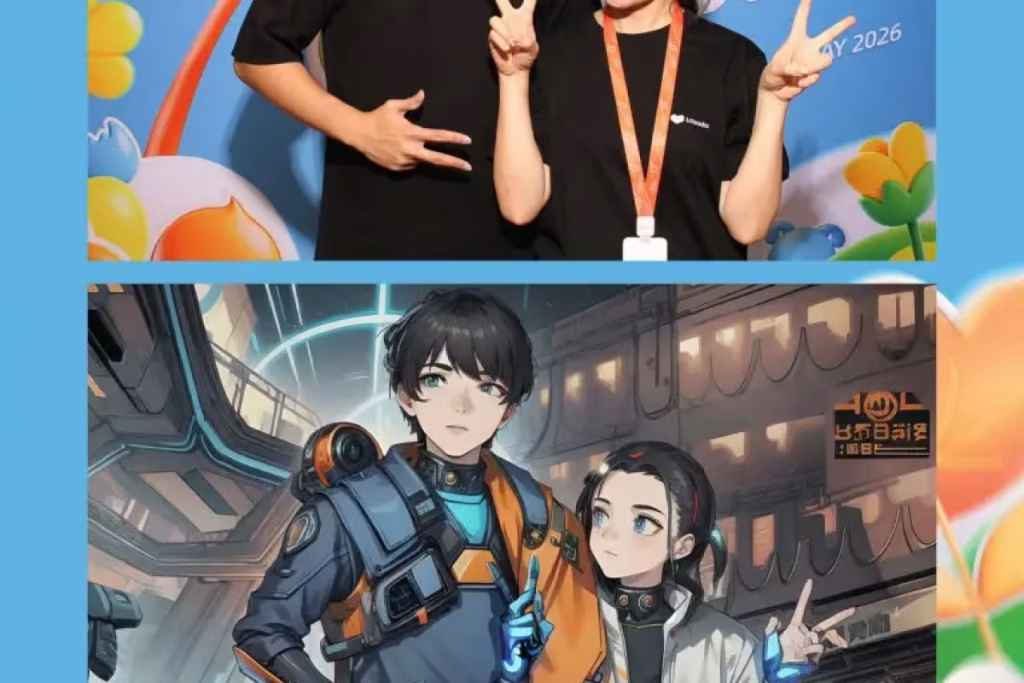
Quick Answer: An AI photo booth in Malaysia can mean a style filter, a generative transformation or an assisted retouch. They cost different amounts and behave very differently in a queue.
Ask three suppliers for an AI photo booth and you will be quoted three different machines doing three different things.
That is not dishonesty. The category grew quickly and the name stuck to everything in it, from a simple styling effect to a full generative rebuild of a guest’s portrait.
The distinction matters because the products fail in different ways and cost different amounts, and because one of them can hold up a queue for several minutes per guest.
Price is the wrong first question. Render time is the right one, because it decides how many guests get a turn, which is the same logic that governs every other booth format.
This guide separates the three, explains what drives the cost of each, and covers the questions worth asking before you book one for a Malaysian event.
Watch: where AI sits in the current booth market
An industry conversation about AI features, portability and what clients are actually asking for. Useful context on how quickly this part of the category is moving.
Source: Ben Sean Herman
2The three products sold as one
Quick Answer: Style filters keep the photograph and change its look. Generative transforms rebuild the image from the photograph. Assisted retouching improves the photograph without changing the person.
| Type | Time per image | Main risk |
|---|---|---|
| Style filter | Near instant | Looks generic |
| Assisted retouch | A few seconds | Over-processing |
| Generative transform | Tens of seconds to minutes | Guest not recognisable |
| Generative with themes | Longest | Inconsistent results |
| Any of the above, cloud based | Adds network time | Stops if the connection drops |
Illustrative planning model rather than measured ShutterPop data. Actual times depend on the system and the connection.
The last row matters more in a ballroom than anywhere else, and it is the one nobody asks about at the quoting stage.
3Render time is the real specification
Quick Answer: Every second of processing is added to every session in the queue. A forty second render at a two hundred guest event is more than an hour of waiting distributed across the evening.
This is the number that should appear on a quotation and almost never does.
A booth that produces a beautiful result in ninety seconds is a different product from one producing a good result in five, even if the images look similar side by side.
The arithmetic is unforgiving. Add the render to the capture, the selection and the delivery, and a generative booth can take three or four minutes per guest.
At that pace a four hour booking serves perhaps seventy people, which is fine at a small event and a serious problem at a large one.
The fix, where the client wants generative results at scale, is more stations rather than more hours, which is the same conclusion our guide to booth hours and throughput reaches for other formats.
4What actually drives the cost
Quick Answer: Processing cost per image, licensing for the software, custom theme development, connectivity and crew. The hardware is the least significant part.
An AI booth is priced differently from a print booth, and understanding why makes the quotes readable.
Generative processing has a cost per image. Every render consumes computing resources, so unlike a print booth where the marginal cost is paper, volume genuinely costs the supplier money.
Software licensing is the second line. Most operators license a platform rather than building one, and that is a recurring cost carried into every booking.
Custom themes are the third, and they are the one clients underestimate. A generic style set is included; a look built around your brand or your event theme is development work.
Connectivity and crew make up the rest, and both matter more here than in other formats, because a stalled render needs somebody to notice and intervene.
Crew cost is not a padding line either. The national minimum wage rose to RM1,700 in February 2025, and an AI booth needs an attendant who can manage expectations as well as equipment, which is a more demanding role than standing beside a print booth.
Service tax is the last thing to check on the quotation. It applies to rental and leasing services at 6 per cent from 1 January 2026 for suppliers above the registration threshold, so ask for the total payable rather than comparing headline rates.
5The retake policy is the honest spec
Quick Answer: Generative results are inconsistent, so ask what happens when a guest dislikes theirs. A supplier with a clear retake rule has run enough events to have needed one.
This is the most useful question in the article and it feels almost rude to ask, which is why people do not.
Generative systems do not produce the same quality every time. Most results are good, some are excellent, and a few come back wrong in ways nobody can predict.
A guest whose portrait looks nothing like them is not delighted by the technology. They are quietly disappointed, and they do not usually complain.
So the operational answer matters. Is there a retake, how many, and does the attendant offer it or wait to be asked?
The best arrangement is generous and bounded: one retake offered proactively, and a fallback to a clean unprocessed photograph if the guest prefers it. That single provision removes the main failure mode of the format.
6Does it look like the guest?
Quick Answer: Likeness is the whole product. A stylised image the guest cannot recognise themselves in will not be kept or shared, however impressive it looks to everyone else.
The measure of an AI booth image is not how striking it is. It is whether the guest sees themselves in it.
That is a low bar in theory and a real problem in practice, because heavier transformations drift further from the original face with every step of stylisation.
The result is a picture the guest finds interesting and does not feel is of them, which is precisely the emotional response that stops it being shared.
Skin tones deserve specific attention in Malaysia, since a diverse guest list will expose any system that handles some tones better than others. Test with several colleagues before the event rather than with one.
Where likeness genuinely matters, such as a corporate directory, the sensible answer is a lighter touch, which our guide to AI headshot booths argues at length.
7Faces, data and consent
Quick Answer: A photograph of a guest’s face is personal data, and cloud processing means it leaves the venue. Ask where images are processed, how long they are kept and whether they are used for anything else.
This is the part of the category that deserves more care than it usually gets.
An AI booth handles images of identifiable people, and in most cases it sends them somewhere to be processed rather than doing everything on the machine in the room.
Malaysia’s framework was strengthened recently, and the Personal Data Protection Department has issued circulars covering data breach notification and the appointment of data protection officers under the amended Act.
The amendments took effect in stages through 2025, with breach notification, data protection officer requirements and data portability commencing in June 2025 and the maximum penalty raised to RM1,000,000 and three years’ imprisonment.
You do not need to be an expert to handle this properly. Ask three questions of the supplier, get the answers in writing, and put a plain notice at the booth, as our guide to consent at events sets out.
8Where an AI booth is worth it
Quick Answer: Themed events, brand activations with a clear creative concept, and moderate guest counts where the queue can absorb the render time.
The format earns its place when the transformation is part of the event’s idea rather than a novelty bolted on.
A themed party is the clearest case. If the event has a world, an AI booth can put guests inside it, and that is something no other booth format can do.
Brand activations are the second, particularly where the concept involves showing guests as something, whether a character, an era or a version of the product’s world.
Moderate guest counts are the practical condition. Under about a hundred and fifty guests, the render time is absorbed comfortably; above that it needs multiple stations.
Where the event has no theme and the objective is simply to entertain, a faster format usually produces a better evening, and our comparison of video and print booths covers those options.
One more condition is worth naming, because it is the one clients resist. An AI booth needs the theme decided early enough for the styles to be built and tested, which means weeks rather than days before the event.
A theme agreed the week before will be run on stock presets, and stock presets are exactly what makes an expensive booth look like an app anyone could have used.
9Print it, do not just show it
Quick Answer: An AI portrait handed over as a print is kept. The same image delivered only to a phone is admired once and lost in a camera roll.
Most AI booths are sold as digital-only, and that is a missed opportunity rather than a technical limit.
The images these booths produce are unusual, which is exactly the quality that makes a print worth keeping. Nobody frames an ordinary photograph of themselves at a work dinner.
A printed AI portrait, on the other hand, is an object people show to other people, and it does the thing a digital file struggles with, which is to persist.
It also solves a delivery problem. A print is handed over immediately, so a slow network stops being able to ruin the guest’s experience.
The economics are straightforward, and the wider argument for physical output is in our comparison of print and digital booths.
10Seven questions before you book
Quick Answer: Type, render time, retake policy, connectivity, data handling, custom themes and whether printing is available.
Send these to every supplier you are considering, unchanged.
- Which of the three types is this, and what exactly happens to the photograph?
- What is the render time in seconds, and how many guests per hour does that allow?
- What is the retake policy, and is a clean unprocessed photo available?
- Does processing happen on site or in the cloud, and what if the connection drops?
- Where are images processed and stored, for how long, and are they used for anything else?
- Are custom themes included, and what is the lead time for one?
- Can it print, and at what additional cost?
Any supplier who answers all seven precisely is worth booking. One who is vague about render time or data handling is telling you something useful.
Considering an AI booth?
Tell us your theme and guest count and we will tell you which type suits it and how many guests it can realistically serve — see our AI photo booths →
11Conclusion
Quick Answer: Establish which type you are being quoted, ask for render time in seconds, insist on a retake policy, handle the data question properly and add printing.
An AI photo booth in Malaysia is a genuinely good product when it is bought with clear eyes.
The confusion in the category is about naming rather than quality, and asking two or three specific questions resolves it immediately.
Establish the type and the render time, agree what happens when a result disappoints, and make sure the guest can hold the picture rather than only see it.
For the specific applications, see our guides to AI cartoon booths for children and to AI headshots for company teams.
12Frequently asked questions
What does an AI photo booth actually do?
It depends which type you book. A style filter changes the look of the photograph, an assisted retouch improves it without changing the person, and a generative transform rebuilds the image into a new portrait based on the original.
How much does an AI photo booth cost in Malaysia?
More than a standard print booth, mainly because of per-image processing costs and software licensing rather than hardware. Custom themes, printing and additional stations are the usual extras on a quote.
How long does an AI photo booth take per guest?
Anywhere from a few seconds for a style filter to several minutes for a themed generative render. Ask for the render time in seconds, since it is added to every session and decides how many guests take part.
Is guest data safe in an AI photo booth?
It depends on where images are processed and how long they are kept. Ask whether processing happens on site or in the cloud, what the retention period is and whether images are used for anything else, then say so at the booth.
Can an AI photo booth print the results?
Many can, and it is worth adding. AI portraits are unusual enough that guests keep the printed version, and handing over a print removes the risk of a slow venue network spoiling the delivery.
Want an AI booth that suits your event?
Tell us the theme, the guest count and the window you have. We will recommend a type, quote the render time honestly and say if a simpler booth would serve you better.