Last updated: 3 September 2026
1Introduction
Quick Answer: Choose a traditional book if you want a complete list of who attended. Choose a video guest book if you want a smaller number of genuine messages, and only if the supplier delivers edited, individually clipped files.
The signing book has been on the registration table at Malaysian receptions for decades. The video booth is the newer arrival, and every article about it is written by somebody renting one.
Both are usually compared on charm, which settles nothing. A book is charming. A recorded message from your grandmother is charming. You could buy either and be happy.
The useful comparison is arithmetic. What proportion of your guests will leave something behind, how substantial that something is, and whether you will ever return to it. Those three questions separate the two formats sharply.
Watch: an honest look at the guest book phone
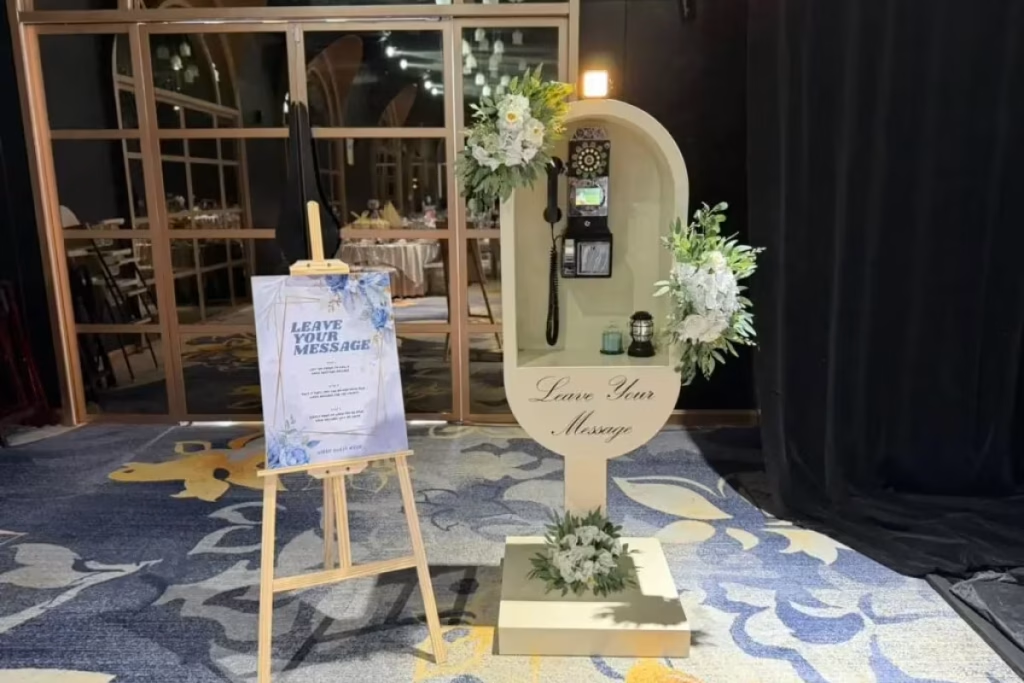
A review of the recorded-message phone that started the category, including what the recordings are actually like afterwards. Useful for setting expectations before you rent anything.
Source: For You Reviews
2What each format actually collects
Quick Answer: A traditional book at a Malaysian reception collects mostly names, because people sign it in a queue on the way in. A video booth collects messages, because guests use it when they have time.
Watch a registration table for ten minutes and the mechanism is obvious. Guests arrive in a cluster, hand over an envelope, sign, and move on because there are eight people behind them. Almost nobody writes a paragraph standing up with a queue at their shoulder.
The book therefore ends up as an attendance record with a handful of longer notes from early arrivals and close family. That is genuinely valuable, and it is not what the brochure photograph of a beautifully written page suggests.
A video station sits somewhere else in the room and is used mid-evening, when guests are between courses and relaxed. Fewer people use it, but the ones who do speak for thirty to ninety seconds, which is a different kind of record entirely.
Scale sharpens the difference. The Department of Statistics Malaysia recorded 190,304 marriages in 2024, and a large share of them are catered receptions with hundreds of guests. At that size a signing book is genuinely the only practical way to record who attended, and equally it is the reason nobody writes anything longer than a line in it.
3Coverage against depth
Quick Answer: Expect high participation and shallow entries from a book, and low participation with substantial entries from a video station. The total amount of meaning collected can be similar.
| Format | Guests who take part | Typical entry |
|---|---|---|
| Signing book at the door | Most | A name, sometimes a line |
| Signing board or canvas | Many | A name and a scribble |
| Message cards on tables | Some | Two or three sentences |
| Recorded audio phone | Fewer | Twenty to sixty seconds |
| Video guest book station | Fewer | Thirty to ninety seconds |
| Photo booth with a note slot | Many | A photo and a short line |
Illustrative planning model of typical behaviour at Malaysian receptions, not measured ShutterPop data. Participation varies with placement, staffing and how the format is announced.
The last row is the quiet compromise, and it is why many couples end up there. A booth that prints two copies, one for the guest and one stuck into a book beside a handwritten line, collects at photo booth rates and keeps some of the substance.
4The language argument nobody makes
Quick Answer: A written book quietly excludes relatives who would rather speak than write in English. A spoken format reaches them, which at a multilingual Malaysian wedding is a real advantage.
This is the strongest local argument for a video guest book wedding station, and imported articles never raise it because their weddings are monolingual.
Malaysian receptions are not. Department of Statistics Malaysia figures from the Current Population Estimates 2025 put Bumiputera at 70.5 percent of 30.9 million citizens, Chinese at 22.2 percent and Indians at 6.5 percent. A single guest list frequently spans several home languages and two or three generations.
An older relative who speaks beautifully in Hokkien, Tamil or Malay may write two cautious words in an English book, or skip it. Handed a microphone, the same person talks for a minute. The format decides whose voice survives.
Set the on-screen prompt in more than one language and this effect gets stronger. It costs nothing and it changes who approaches the station.
5The failure that matters: nobody watches it
Quick Answer: An unedited file of ninety minutes gets watched once. If your supplier does not deliver individually clipped messages and a short edit, buy the book instead.
Here is the part a company renting video booths would rather not lead with. The common failure is not technical, it is that the recording is never opened again.
A book sits on a shelf and gets picked up on an anniversary. A single long video file sits in cloud storage, gets watched once out of duty, and is never opened again, because finding your uncle’s forty seconds means scrubbing through a queue of strangers.
What fixes it is delivery, not hardware. Individually clipped files named by guest, a short highlight edit, and a download that will still work in five years. With those, the recordings behave like the book: dip in, find someone, close it again.
So make delivery the first question you ask, before price and long before which model of handset it is. A cheaper station with proper delivery beats an expensive one that hands you a raw dump.
There is a second, quieter failure worth naming. Cloud links expire, drives are lost, and a wedding keepsake has to survive years rather than weeks. Ask where the files live after the download link stops working, and save a copy somewhere you control on the week you receive it. Nobody does this, and it is the reason recordings from weddings a decade ago mostly no longer exist.
6Audio, video or both
Quick Answer: Audio is less intimidating and works in a noisy hall only with a handset. Video captures expression but makes self-conscious guests hesitate. Video with a handset gets most of both.
The two formats behave differently in a full banquet hall.
An audio handset is the easier ask. Guests pick it up, speak into it privately, and hang up. Nobody is on camera, and the handset holds the microphone close enough that the band and four hundred conversations stay in the background.
Video adds faces, which is most of the emotional value, and asks more of the guest. An open camera in a busy room makes people perform or refuse; a small booth with a curtain or a corner away from the tables makes them relax.
The practical answer for a Malaysian ballroom is video with a handset or a headset microphone, sited away from the speakers. Rooms are loud, and a station using only a built-in microphone returns messages you cannot hear.
7Where to put it, and when
Quick Answer: Not at the registration table. Put it where guests pass mid-evening, with a quieter background, and announce it once from the stage during the movement window.
Placement decides participation more than the equipment does.
The registration table is the wrong home for a recording station. Guests are arriving, handing over envelopes and being ushered in, and there is a queue. That is the correct place for the signing book and the worst place for a message.
The right position is on the route people take mid-evening, near the booth or the dessert table, in a corner where the band is not directly behind the guest. Ours is a room-sound problem as much as a footfall one.
Timing matters too. Malaysian receptions have a short window when guests genuinely move, and everything interactive competes for it. That window is the same one your booth depends on, which is why the booking timeline puts the programme before the equipment.
8What it costs you, beyond the fee
Quick Answer: A recording station costs floor space, a share of the movement window and someone’s attention on the night. Those are the expensive parts at a busy reception, not the rental line.
Compare the two on the invoice and the book wins easily. Compare them on what they consume at the event and the picture is less clear.
A book takes a corner of the registration table and no attention at all. A recording station takes floor space, power, a quiet-ish corner and a slice of the same movement window your booth is using. At a packed banquet those are genuinely scarce.
It also needs a person. Not a full attendant necessarily, but somebody who invites people over, because a station nobody explains is used by about a third of the guests it should be.
Set against the numbers in our cost guide, the sensible order at most Malaysian weddings is booth first, recording station second, and the book kept regardless because it costs almost nothing.
9What to confirm before you book one
Quick Answer: Clipped files, a highlight edit, the microphone type, prompts in your languages, storage backup, and how long the download stays live. Six answers decide the whole purchase.
| Ask | Answer to want | Why |
|---|---|---|
| How are files delivered? | One clip per message | A single long file is unusable |
| Is there an edit? | A short highlight reel | It is the version you will share |
| What microphone? | Handset or headset | Ballrooms are loud |
| Can prompts be multilingual? | Yes, your wording | It changes who takes part |
| Where is it stored? | On device and backed up | Nothing can be re-recorded |
| How long is the download live? | Months, with an archive | Links expire quietly |
Checklist used in this guide. Suppliers differ; the point is to get the answers in writing before the deposit.
Delivery to guests is a separate matter and worth asking about. Figures from the ICT Use and Access Survey 2025, released on 23 April 2026, put mobile phone use by individuals at 99.6 percent, so a guest can be sent their own clip within minutes if the supplier has set that up.
10Running both without doubling the cost
Quick Answer: Keep the book at the door for coverage and add a recording station or a booth with a note slot in the room for depth. The book costs very little, so the real decision is only about the second station.
Framing this as a choice is mostly a habit of articles that sell one of the two. In practice a signing book costs a fraction of any rental, so there is no reason to drop it.
The productive version is a division of labour. The book takes attendance at the entrance. The station in the room takes messages from whoever wants to leave one. Neither competes with the other because they sit in different places at different moments.
If the budget only stretches to one rental, the photo booth usually earns its place first, because it serves far more guests. Adding a note slot and a second print turns it into a partial guest book, which is the compromise described in our wedding photo booth ideas.
Then, if there is room left, add the recording station for the people whose voices you want to keep. Priced that way it stops being a competitor to the book and becomes what it actually is: a small, targeted purchase aimed at a specific handful of relatives whose messages you would pay a great deal to still have in twenty years.
Not sure which station suits your reception?
Tell us your guest count and how long your movement window runs, and we will tell you which combination reaches the most people — see our wedding photo booth range →
11Conclusion
Quick Answer: Keep the traditional book for coverage. Add a video guest book only if the supplier delivers clipped files and an edit, and only if you have the floor space and the movement time to spare.
The choice between a video guest book wedding station and a traditional book is really a choice between a complete list of who came and a partial collection of what they said.
The book is cheap, reliable and shallow. The recording station is richer, reaches relatives a written book quietly excludes, and depends entirely on delivery you have to insist on in advance.
Decide it on those grounds rather than on which looks better in a styled photograph, and you will not regret either answer.
Still planning the rest of the evening? Our guide to props that actually get used covers the other half of the guest experience, or bring us your programme at ShutterPop.
12Frequently asked questions
Is a video guest book better than a traditional guest book?
It is deeper but reaches fewer guests. A book at the door collects nearly everyone’s name, while a recording station collects genuine messages from a minority. Most couples keep the book and add the station rather than choosing between them.
How many guests actually use a video guest book?
Fewer than use a photo booth and far fewer than sign a book, unless somebody invites people over and it is announced once from the stage. Placement in the room and a single announcement make more difference than the equipment does.
What should a video guest book supplier deliver afterwards?
One clip per message, named or numbered, plus a short highlight edit and a download that stays live for months. A single unedited recording of the whole evening is the most common disappointment in this category.
Does a video guest book work in a noisy banquet hall?
Only with a handset or headset microphone held close to the speaker. A station relying on a built-in microphone in a full ballroom records the band and the room more clearly than the guest.
Can guests leave messages in Malay, Chinese or Tamil?
Yes, and they will if the prompt invites it. Setting the on-screen wording in more than one language noticeably increases how many older relatives take part, which is the main advantage a spoken format has over a written book.
Want messages your family will actually watch again?
Tell us your venue, guest count and programme. We will recommend the station and placement that collects the most, from our 40+ booth and video formats.