Last updated: 4 September 2026
1Introduction
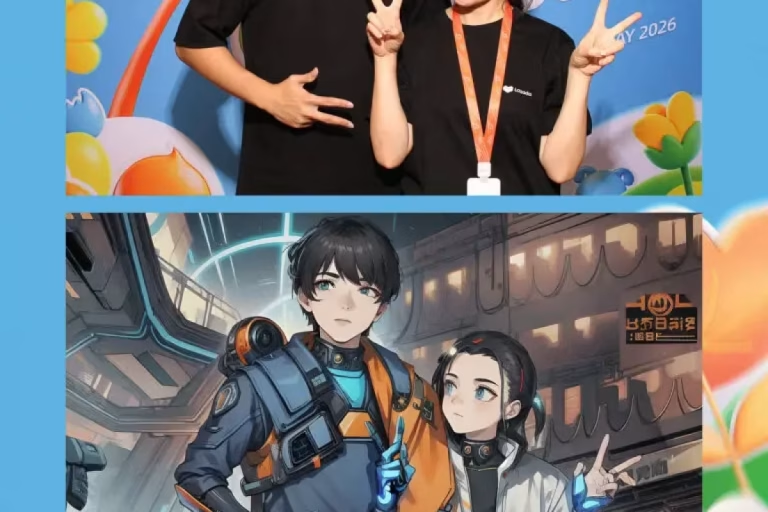
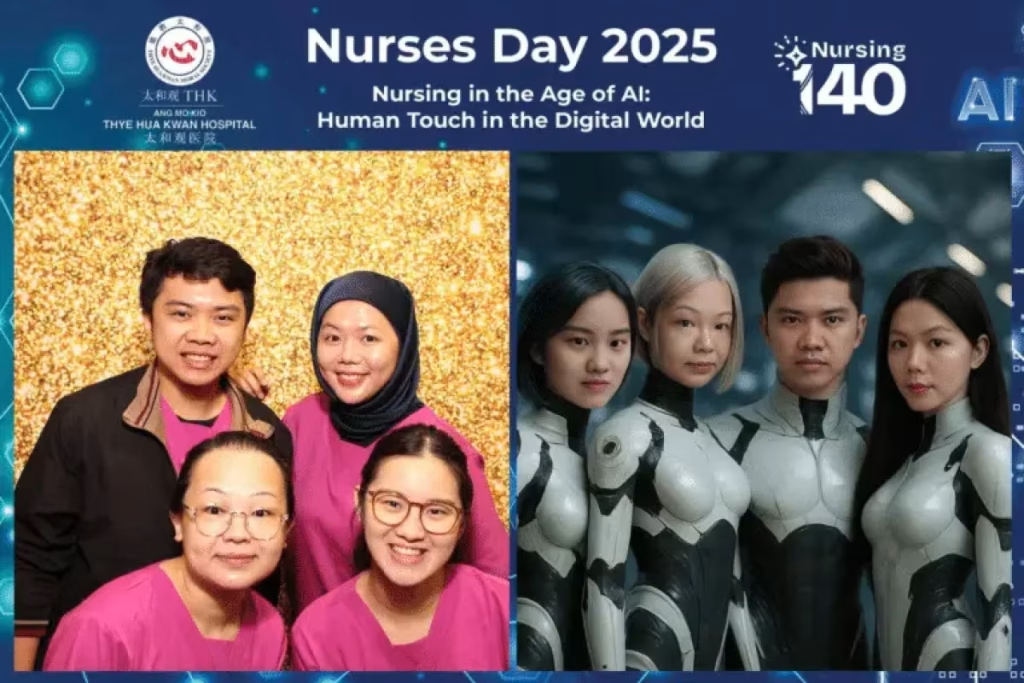
Quick Answer: A face swap photo booth places a guest’s face into a prepared piece of artwork, so they appear as a historical portrait, a film poster or a themed character. The artwork does most of the work.
A face swap photo booth is sold on the promise that a guest can be anything, which is exactly the wrong way to think about it.
In practice a guest can be one of the four to six things you prepared properly, and the difference between a good session and a bad one is decided weeks earlier when somebody chose those images.
Get the artwork right and the result is startling. Get it wrong and every guest receives the same slightly unsettling picture of a face that does not sit on the body it has been given.
This guide is about choosing and testing that artwork, handling head coverings, letting guests pick their own, and telling people honestly what happens to their photograph.
Watch: what a face swap actually does to an image
A plain explanation of how a face swap works technically. Useful background for understanding why some destination images give clean results and others never will.
Source: Alvin Wan
2The destination image decides everything
Quick Answer: A good destination image has one clearly lit, roughly front facing head at a decent size in the frame. Artwork that fails those conditions will fail for every guest, no matter how good the photograph of them is.
This is the whole craft of the format, and it takes an afternoon rather than a budget.
The face in the artwork needs to be large enough in the frame to carry detail. A figure standing at full height in a wide painting gives the swap perhaps forty pixels of face to work with, and no software recovers from that.
It also needs to face roughly forwards. A three quarter angle is fine, a sharp profile is not, because the guest photograph has no data for the side of the head that is turned away.
Lighting comes third. If the artwork is lit hard from one side and your booth lights the guest flat and even, the pasted face reads as flat and even against a shaded head, which is the single clearest giveaway.
Test each candidate image with four or five different faces before the event, including at least one person wearing glasses. Discard anything that only works with one of them.
3Head coverings, and why most templates fail here
Quick Answer: Almost every off the shelf face swap template has hair in it. For a guest in a tudung, songkok or turban that produces an obviously wrong picture, so the artwork has to be chosen with head coverings in mind.
This is the most Malaysian problem with the format and the one imported templates never anticipate.
A face swap replaces a face, not a head. Everything above the hairline belongs to the artwork, so a guest wearing a headscarf receives a picture of themselves with somebody else’s hair.
For many guests that is not a small aesthetic issue, it is a picture they will not want and cannot share.
There are two fixes and both are easy. Choose artwork where the head is already covered, which is straightforward for historical, royal, military and adventure themes. Or crop the template close so the frame ends at the face and the question never arises.
The best events do both, offering a covered set and an uncovered set and letting the guest choose without anyone having to explain why.
4Let the guest choose the joke
Quick Answer: A face swap can be flattering or it can be a joke at somebody’s expense, and the difference is who picked the artwork. Always let the guest choose from a visible menu.
This format has a social risk that no other booth carries.
Putting a guest onto a body of a different shape, age or gender is funny when they chose it and humiliating when an attendant chose it for them.
The fix is a visible menu, on a screen or a printed board, showing every option. The guest points at one and that is the end of the problem.
It also improves the pictures. People choose the thing they secretly want to be, and they pose accordingly, which is worth more than any prompt an attendant can give them.
Keep the menu short. Six options that all work well beats twenty where half are untested, and a long menu turns the queue into a browsing session.
5Themes that work at a Malaysian event
Quick Answer: Broad genres rather than named characters: era portraits, adventure and exploration, royal and ceremonial, film poster styles and sports. Generic themes avoid rights questions entirely.
| Theme family | Suits | What it needs |
|---|---|---|
| Era and heritage portraits | Weddings, family days, anniversaries | Head coverings available, warm even lighting |
| Adventure and exploration | Family days, kids over eight, roadshows | Helmets and hats, which solve hair entirely |
| Royal and ceremonial | Annual dinners, cultural nights | High detail artwork, larger face in frame |
| Film poster styles | Product launches, brand activations | Space in the layout for a title and logo |
| Sports and team | Corporate family days, club events | Group versions as well as single portraits |
Illustrative planning model rather than measured ShutterPop data. Named characters and franchises are excluded because reproducing them raises rights questions.
Named characters are what every client asks for first and the one thing worth talking them out of. A recognisable franchise belongs to somebody, and a generic version of the same genre gets the same reaction from guests.
Match the theme to something already happening at the event. An annual dinner with a decade theme, a family day with an explorer theme or a launch with a poster treatment all reinforce the room rather than competing with it.
Where the event has no theme, era portraits are the safest default. They flatter everybody, they work across ages and they photograph well in the mixed lighting of a Malaysian ballroom.
6Match the light or the swap will show
Quick Answer: The most common technical failure is a mismatch between how the guest is lit and how the artwork is lit. Fix it on the booth side, because the artwork cannot be relit.
Every unconvincing face swap has the same tell, and it is not the software.
The artwork has a direction of light baked into it. If the guest is photographed flat, the swapped face carries no shadow and floats in front of a shaded head.
The practical answer is to light the booth to suit the artwork rather than choose artwork to suit the booth. A single main light slightly to one side matches far more source images than a ring light straight on.
Where the theme set has mixed lighting directions, pick one direction and drop the artwork that fights it. Consistency across the set matters more than any individual image.
Skin tone is the other half of the same question. Ask the supplier to check the set across several colleagues before the event rather than discovering the problem in front of a queue.
7Speed, retakes and how many guests you can serve
Quick Answer: A face swap is one of the faster AI formats because the artwork is fixed and only the face is generated. Budget one retake per guest and the format holds up.
Compared with a full generative portrait this format is quick, which is a large part of its appeal.
The heavy work of composing the scene was done in advance, so the machine only has to solve one face, and sessions of under a minute are realistic.
That speed is worth protecting. Choosing from the menu is the slowest part, so a printed board that guests read while queueing does more for throughput than any faster hardware.
Budget one retake per guest as policy rather than as a favour. Face swaps occasionally come back with an odd expression or a misaligned jaw, and a second attempt fixes almost all of them.
The queue arithmetic in our guide to AI photo booth costs and render times applies here, with this format sitting at the fast end of the range.
8The deepfake question, and what to tell guests
Quick Answer: Some guests will hesitate, and the honest answer is specific rather than reassuring: the image is processed to make their picture, it is not kept afterwards, and it is not used to train anything.
Face swapping carries an association that no other booth format does, and pretending otherwise is a mistake.
A guest who has read about manipulated video is asking a reasonable question when they ask what happens to their face, and a vague answer makes them more suspicious, not less.
So get the specifics from your supplier and print them on a small card at the booth. Where images are processed, how long they are kept and whether they are used for anything else.
Malaysia’s amended data protection framework has applied in stages since 2025, and the Personal Data Protection Department has issued circulars on breach notification and data protection officers under it.
Keep the gallery private, keep the marketing opt in separate from the photograph, and the format stops being a question at all. The approach is the same one our guide to consent and data at events sets out.
9Couples, groups and the seating problem
Quick Answer: Group artwork is a separate build, not a setting. If you want couples or teams in one frame, ask for it specifically, because a single portrait template cannot be stretched to fit three people.
Almost every enquiry eventually asks whether two people can be in the same picture, and the answer depends entirely on preparation.
A destination image has a fixed number of faces in it. Two guests need artwork with two heads in it, positioned at similar sizes and lit the same way, which is a different image rather than a different button.
That makes group artwork worth commissioning deliberately for the events where it matters. A couple at a wedding, a pair of directors at an annual dinner or a department at a family day all want to appear together.
There is a practical limit. Beyond about four faces, each one is small enough in the frame that the detail falls away and the result stops being recognisable, which defeats the point.
Where a group shot is the main request, a booth format built for groups may serve the event better, and our guide to corporate booth formats works through which ones handle a crowd.
10A short brief for your supplier
Quick Answer: Six things to settle before the day, all of which are decisions rather than costs.
Send this to whoever is quoting for the booth.
- Four to six destination images, tested on several faces including glasses.
- A covered head set so guests in a tudung or songkok get a usable picture.
- A visible menu so every guest chooses their own artwork.
- One consistent lighting direction across the whole set.
- One retake per guest as standard policy, not as a favour.
- Written answers on processing, retention and reuse of guest photographs.
The first two are the ones that get skipped, and they are the two that decide whether the booth works for the room you actually have.
It is also worth asking for the artwork set a week early. Looking at six images on a screen takes ten minutes and catches almost every problem in this article before it reaches a guest.
Planning a themed event?
Tell us the theme and your guest mix and we will build and test the artwork set before the day, including a covered head version. see our AI booths →
11Conclusion
Quick Answer: Curate the artwork, cover the head coverings, let guests choose, match the light and answer the privacy question specifically. The software is the easy part.
A face swap photo booth is the one AI format where nearly all the quality is decided before the event begins.
Four to six well chosen and properly tested images, offered on a visible menu, with a covered head option and a single lighting direction, will produce pictures guests actually keep.
A generic template pack bought off a shelf will produce a hundred near misses and a queue that thins out after the first few guests see the results.
For the wider category see our guide to AI photo booths in Malaysia, and for the other transformation format guests ask for by name, our guide to action figure booths. The full range is on the ShutterPop site.
12Frequently asked questions
What is a face swap photo booth?
A booth that photographs a guest and places their face into a prepared piece of artwork, so they appear as a portrait, a poster or a themed character. The artwork is chosen and tested in advance rather than generated on the spot.
Does a face swap booth work for guests wearing a headscarf?
Only if the artwork was chosen for it. A face swap replaces the face and keeps the artwork’s hair, so pick images where the head is already covered or crop the template close to the face.
Can we use a famous character or film for the theme?
Named characters and franchises raise rights questions, so a broad genre such as era portraits, adventure, royal or film poster styling is safer. Guests respond to the genre rather than the specific title.
Why do some face swaps look obviously wrong?
Usually because the artwork was unsuitable. A face that is small in the frame, turned to the side or lit from a sharply different direction than the booth will produce a poor result for every guest.
Is a face swap photo booth safe with guest photographs?
It can be, and the answer should be specific. Ask the supplier where images are processed, how long they are kept and whether they are used for anything else, and put a short version of the answer on a card at the booth.
Want a face swap booth that actually suits your guests?
Send us your event theme, date and guest mix. We will prepare and test the artwork set, including covered head options, and show it to you before the day.