Last updated: 4 September 2026
1Introduction
Quick Answer: The main 360 booth requirements are a clear circle for the arm to swing through, a level surface for the platform, adequate ceiling height and one reliable power point. Mechanical safety matters more than electrical load.
Every venue asks the same first question about a 360 booth, and it is the wrong one.
They ask how much power it needs. The honest answer is not very much, and certainly less than the print booth that has been in the same ballroom a hundred times without incident.
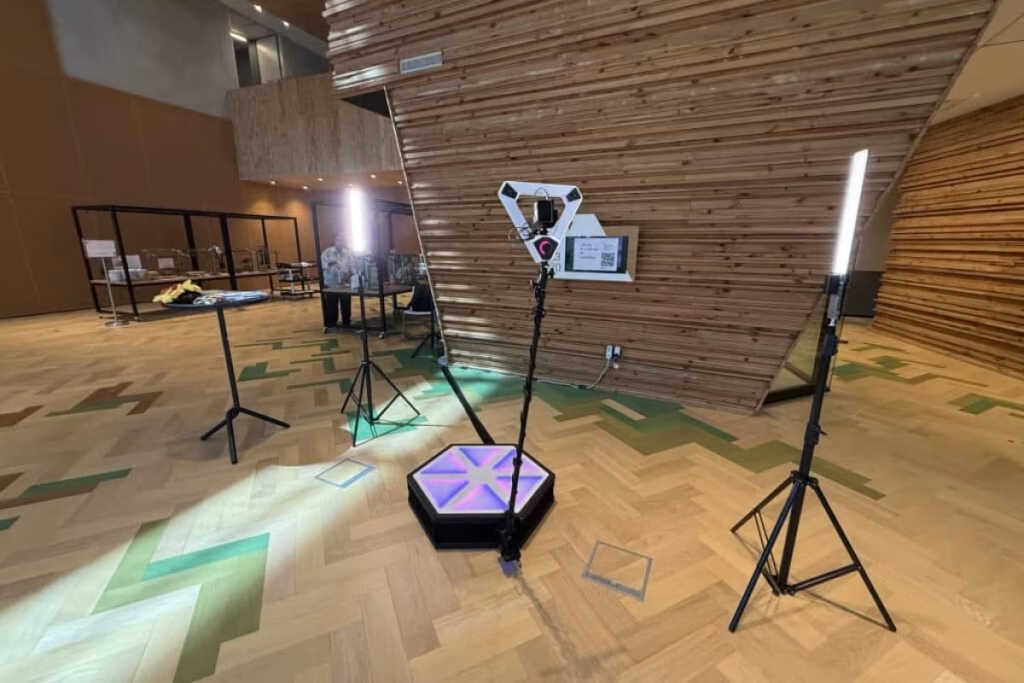
What deserves the attention instead is the physical envelope. This is the only common booth format with a moving part travelling at speed near people’s heads, and the only one that raises guests off the floor.
Neither of those is dangerous when planned. Both become dangerous when the booth is squeezed into a space that was measured for something else.
This guide sets out what a 360 booth actually needs, what a venue will want to hear, and the specific things that go wrong in Malaysian ballrooms and outdoor settings.
Watch: a 360 booth being set up and operated
A practical setup and review video. Watch how much floor area the arm sweeps through compared with the size of the platform itself.
Source: CrewElite
2Why the power question is the easy one
Quick Answer: A 360 booth runs a motor, a camera, a tablet and lighting. There is no printer, and a printer is what makes an instant print booth the heavier electrical load.
Instant print booths draw their peak load from the printer, which uses heat to transfer dye onto paper and spikes every time it runs.
A 360 booth has none of that. The motor turning the arm is small, the camera and tablet are trivial, and lighting is the only meaningful consumer.
So the electrical requirement is usually a single standard socket, and venues that have hosted print booths have already accommodated more demanding equipment.
The one thing worth insisting on is a dedicated point rather than a shared one. A booth sharing a circuit with catering equipment can be knocked out by a coffee urn, not by its own consumption.
Ask for the socket location during the site visit, not on the day. The distance from the socket to the booth position determines cable runs, and cable runs across a guest route are a separate problem entirely.
3Cables, extensions and who is allowed to do what
Quick Answer: Use one properly rated extension, tape or mat every cable crossing a walkway, and never let anyone other than a competent person touch the venue’s installation.
Most electrical incidents at events are not about load. They are about cables and about people improvising.
Daisy chaining extension leads is the classic mistake. Two or three sockets bridged together to reach a distant point is common, unnecessary and the source of most avoidable faults.
Anything crossing a route guests walk needs to be taped down or covered with a mat, and that includes the short run behind a backdrop where a guest will inevitably step.
Work on the venue’s own installation is a different category altogether. In Malaysia, anyone carrying out, supervising or taking responsibility for electrical works must be registered by the Energy Commission as one of its competent person categories, which include chargemen, wiremen and electrical supervisors.
That is a matter for the venue rather than the booth supplier. What a booth company should do is plug into a point provided by the venue, and say so plainly if the point offered is unsuitable.
4The swing circle is the real specification
Quick Answer: Measure the circle the arm travels through and add a margin beyond it. That total, not the platform diameter, is the space the booth occupies.
Almost every space problem with a 360 booth traces back to somebody measuring the platform.
The platform is small. The arm extends well beyond it, and the safe area extends beyond the arm, because a bystander leaning in to film on their phone will otherwise be inside the sweep.
| Measurement | What it covers | If it is missed |
|---|---|---|
| Swing circle | Arm path plus safety margin | Bystanders clipped by the arm |
| Ceiling height | Platform plus tallest guest | Guests ducking under fittings |
| Queue area | Waiting guests and spectators | Crowd spills into a walkway |
| Floor level | Platform stability | Wobble, session stopped |
| Cable route | Socket to booth distance | Trip hazard across a route |
| Egress clearance | Fire routes and exits | Refused by the venue on the day |
Illustrative planning checklist rather than measured ShutterPop data. Confirm exact dimensions with your supplier.
The last row is the one that ends bookings. A booth blocking an exit route will be moved or shut down regardless of what was agreed in advance.
5The platform is the biggest liability
Quick Answer: Guests step up onto a raised surface, often in formal shoes and often after a drink. A non-slip surface, a marked edge and an attendant offering a hand cover almost every incident.
If something goes wrong at a 360 booth it is overwhelmingly likely to involve the platform rather than the machine.
The step up is small enough that nobody treats it as a step, which is precisely why people misjudge it. Long dresses, heels and dim lighting make it worse.
Three things fix most of it. A non-slip surface, an edge that is visually distinct from the floor around it, and an attendant who offers a hand as a matter of routine rather than only when someone looks unsteady.
Jumping is the other one. Guests jump on the platform because slow motion makes it look good, and a raised surface with several people on it is not the place for it.
Set that expectation before the session rather than mid-session. A cheerful instruction to keep both feet down is accepted easily at the start and resented halfway through.
6Managing the crowd around it
Quick Answer: Spectators stand closer than they should because they are filming. Mark the safe boundary on the floor and staff the booth with someone whose job is the crowd rather than the camera.
A 360 booth attracts an audience, which is one of its best features and its main safety consideration.
The specific problem is phones. A spectator filming a friend steps forward without noticing, and their arm ends up inside the arc the arm travels through.
Floor marking solves most of this quietly. A taped line or a low barrier gives people a place to stand, and most guests respect it without being asked.
The rest is staffing. One attendant cannot run sessions, handle delivery and watch a crowd at the same time, which is a large part of why the second crew member matters.
Children need a specific mention. They move quickly, they are below adult eye level, and a 360 booth at a family event should have someone whose attention is on the perimeter, which our guide to family day booths also covers.
7Outdoors changes everything
Quick Answer: Outdoor setups need a firm level base, cover over the equipment, a plan for rain and protection for every electrical connection. Humidity and sudden downpours are the constraints, not heat alone.
An outdoor 360 booth is a different job from an indoor one and should be quoted as such.
The ground comes first. Grass, uneven paving and soft surfaces all destabilise a platform, and boards or a solid base are not optional.
Weather is the second constraint and it is specific here. The Malaysian Meteorological Department records relative humidity across the peninsula in the eighty per cent range with daily maxima above ninety, and heavy rainfall through the monsoon months.
So cover the equipment before you cover the queue, keep every connection off the ground and out of standing water, and agree a covered fallback position that also has power.
Wind deserves a mention too. A backdrop behaves like a sail, and an unweighted frame near a rotating arm is a genuinely bad combination.
8What the venue will want in writing
Quick Answer: Dimensions, power draw, weight, setup time, crew numbers and insurance. One page answering all six usually gets approved the same day.
Venues are not obstructive about 360 booths. They are cautious about equipment they have not seen described.
The single page that unlocks approval covers the footprint including swing clearance, the electrical requirement, the total weight on the floor, how long setup takes, how many crew attend and what insurance is in place.
Weight matters more than people expect in some settings. A raised floor, a mezzanine or a marquee deck has a loading limit, and a platform with five adults on it concentrates weight in a small area.
Insurance is usually the item that decides how quickly the venue replies. A supplier who can produce a certificate without being chased is treated very differently from one who cannot.
It is worth understanding why venues ask at all. A hotel is protecting a fire certificate, an insurance position and a room that has to be handed to another client the next morning, so the questions are about their exposure rather than about your event.
Answering in those terms speeds everything up. Say what the booth weighs, where the cables run and who is on site to stop the machine, and the conversation stops being a negotiation.
How to assemble and send that page, and what each question is really asking about, is set out in our guide to getting venue approval.
9Setup, packdown and the access window
Quick Answer: A 360 booth needs the room before guests arrive, not while they are arriving. Confirm the access time in writing, because a late room release compresses safety checks.
The most common cause of an unsafe setup is not carelessness. It is time.
A crew given ninety minutes will level the platform, route the cables properly, mark the boundary and test a few sessions. The same crew given twenty minutes will skip the parts nobody can see.
So the access window belongs in the booking rather than in a conversation on the day. Ask what time the room is released and what time guests arrive, and check there is a real gap between them.
Packdown deserves the same attention. Dismantling a platform while guests are still in the room is worse than setting one up in a hurry, because now there is an audience and drinks.
Where the timing is genuinely tight, the sensible answer is to place the booth where setup does not interfere with the room, which our guide to space requirements helps you work out in advance.
10A checklist for the organiser
Quick Answer: Seven items to confirm before the day, all of which can be settled by email.
None of this needs technical knowledge. It needs someone to ask and write the answers down.
- Swing clearance confirmed as a circle, with the position marked on a floor plan.
- Ceiling height checked against platform height plus a tall guest.
- A dedicated power point identified, with the cable route agreed and covered.
- Floor level and load confirmed, particularly on raised or temporary flooring.
- Two crew attending, one of them responsible for the perimeter.
- Exit routes unobstructed, checked with the venue rather than assumed.
- Access and packdown times written into the booking.
Seven answers, one email thread, and almost every problem this article describes stops being possible.
Venue asking for specifications?
We will send you a one page document with dimensions, power, weight and insurance, ready to forward to your venue — see our 360 video booth →
11Conclusion
Quick Answer: One dedicated socket, a measured swing circle, a level non-slip platform, a marked perimeter, two crew and a confirmed access window.
The 360 booth requirements that matter are almost all physical, and none of them are difficult.
Power is straightforward, and treating it as the main question is what leaves the genuine risks unexamined.
Measure the circle, level the platform, mark the boundary, staff the perimeter and confirm the access window. That is the whole safety case, and a venue that sees it written down approves quickly.
For the format itself, our guide to how a 360 booth works covers the session, and our guide to 360 booth pricing explains where crew and lighting sit in a quote.
12Frequently asked questions
How much power does a 360 photo booth need?
Usually a single standard socket. The motor, camera and tablet draw very little, and lighting is the main consumer, which makes a 360 a lighter electrical load than an instant print booth with a heated printer.
How much space does a 360 booth need?
Enough clear floor for the full circle the arm travels through, plus a safety margin so spectators cannot reach into it. The platform diameter alone significantly understates the space required.
Is a 360 photo booth safe for guests?
Yes, when the platform has a non-slip surface and a visible edge, an attendant offers a hand at each session, jumping is discouraged and a marked boundary keeps spectators clear of the rotating arm.
Can a 360 booth be set up outdoors in Malaysia?
Yes, with a firm level base, cover over the equipment, connections kept off the ground and a covered fallback position that also has power. High humidity and sudden monsoon rainfall are the main constraints.
What will the venue ask for before approving a 360 booth?
Dimensions including swing clearance, power requirement, total weight, setup and packdown times, crew numbers and proof of insurance. One page covering all six is usually enough for a same-day answer.
Need the specifications for your venue?
Send us the venue name and the room. We will confirm the clearance, the power point and the access window, and give you a document your venue can approve from.