Last updated: 4 September 2026
1Introduction
Quick Answer: A magic mirror is a full length touchscreen mirror that guides guests through a session. An instant print booth is a camera, a light and a printer. Both print a photograph on the spot.
Magic mirror vs instant print is presented as a choice between two different products at two different prices, and the photographs they produce are very close to identical.
Both use a camera and a light and both hand a printed picture to a guest within seconds. Neither has a meaningful quality advantage over the other.
What differs is everything around the photograph: how the guest interacts with it, what the rest of the room sees, how much floor it needs and how many people it serves in an hour.
So the honest comparison is not about image quality at all. It is about your venue, your programme and whether the booth needs to attract attention or process a crowd.
Watch: why a printed photograph behaves differently
A photographer on what changes when an image becomes a physical object. It explains why the print, which both these booths produce, is the part guests keep.
Source: Shoot On Film – with Ari Jaaksi
2What a magic mirror actually is
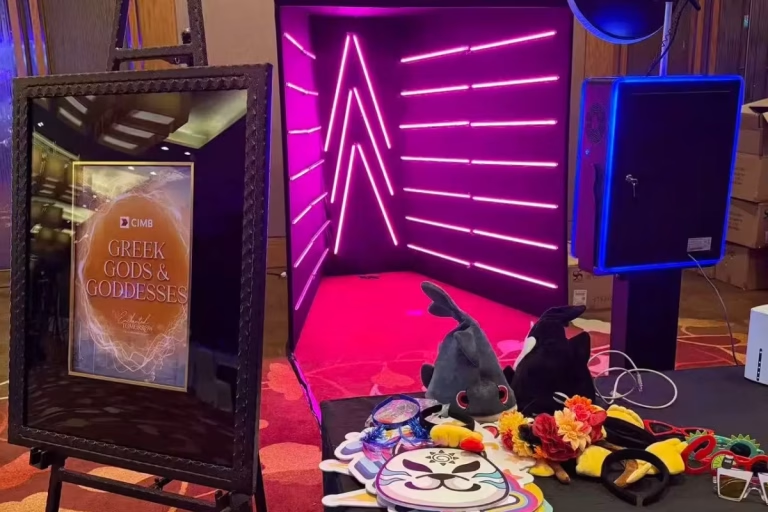
Quick Answer: A full length mirror with a screen behind it. Guests see themselves at full height, follow animated prompts on the glass and often sign the screen before the print comes out.
The appeal is immediate and it is theatrical rather than technical.
A guest walks up to what appears to be an ornate full length mirror, and the mirror talks to them, counts down, and reacts.
Because it is full length, it photographs the whole outfit, which matters a great deal at events where guests have dressed for the occasion.
The signature feature is the touchscreen. Guests sign or draw on the glass and their signature appears on the print, which almost nobody remembers to use and which is the best thing about the format.
The full wedding experience of one, including what to expect on the night, is in our guide to magic mirror booths at weddings.
3What an instant print booth actually is
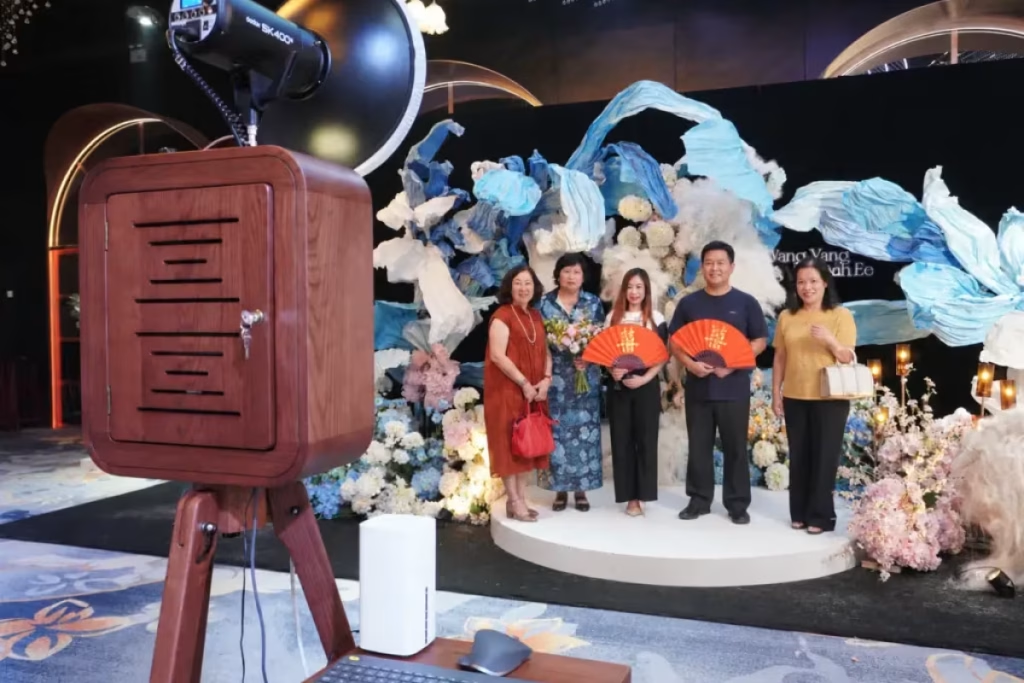
Quick Answer: A camera, a light, a screen and a printer, in an enclosure or on a stand. Guests press a button, pose, and take a print. It is the fastest format in the range.
The instant print booth is the original and it remains the most efficient thing in the category.
There is very little to explain to a guest. Press the button, look at the camera, collect the print, which is why the queue moves.
It is usually framed for head and shoulders or a small group, so it suits crowds better than it suits showing off an outfit.
It also occupies far less floor and can be set up in a corner, a corridor or against a wall where a mirror simply will not go.
The classic strip layout is part of the appeal, and it is the format people picture when they think of a photo booth at all.
4The mirror recruits, the booth processes
Quick Answer: A mirror is visible across a hall and draws people to it. A print booth serves more of them once they arrive. Which one you need depends on your problem.
This is the difference that matters and it is rarely how the two are compared.
A magic mirror is a piece of furniture that people notice. It stands alone, it is lit, and a guest using it is visible to the whole room, which pulls others over.
An instant print booth is quieter. It does not announce itself in the same way, and it relies on placement and an attendant to recruit.
But once guests arrive, the print booth serves them faster, because a session is shorter and there is nothing to browse or sign.
So if the problem is that nobody walks over, the mirror helps. If the problem is a hundred and fifty people and one busy hour, the print booth helps.
5Space, floor and light
Quick Answer: A mirror needs depth for full length capture, a level floor and control over reflections. An instant print booth needs a fraction of that and tolerates a difficult room.
| Requirement | Magic mirror | Instant print |
|---|---|---|
| Floor space | Larger, needs depth | Compact |
| What it captures | Full length | Head and shoulders or small group |
| Sensitivity to room lighting | Higher, reflections matter | Lower |
| Guests served per hour | Fewer | More |
| Setup time | Longer | Shorter |
Illustrative planning model rather than measured ShutterPop data. Exact requirements vary by unit and by venue layout.
The lighting row is the one people are unprepared for. A mirror is a reflective surface, so spotlights, chandeliers and windows behind the guest all show up in a way they do not with a conventional booth.
The floor matters too. A tall unit on an uneven surface or a temporary stage needs care, which is worth raising at the site check rather than on the night.
The floor areas for each format are set out in our guide to booth space requirements.
6Which one suits a Malaysian banquet
Quick Answer: For a full length outfit at a wedding or an annual dinner, the mirror. For a crowded hall with a short guest movement window, the instant print booth.
Both formats appear at Malaysian events constantly, and the choice usually resolves on two questions.
The first is what guests are wearing. At a wedding, a raya open house or an annual dinner with a dress code, full length capture is a genuine advantage, because the outfit is the effort.
The second is the shape of the evening. A banquet gives roughly an hour of real guest movement around arrival, and a faster format serves more of the room inside it.
Where both matter, some events run a mirror during arrival and accept that it will not serve everybody, treating it as a feature rather than a service.
The hour placement argument behind that is in our guide to how many booth hours you need.
7Cost, and what the difference buys
Quick Answer: A mirror generally costs more than an instant print booth for the same hours. The premium buys presence and full length capture, not better photographs.
The price gap is real and it is worth understanding what sits inside it.
A mirror is a larger, heavier and more expensive piece of equipment, it takes longer to set up and it usually needs more careful placement.
What it does not buy is image quality. Both formats use comparable cameras, lighting and printers, and a well run instant print booth produces pictures just as good.
So the question is whether presence and full length capture are worth the difference at your event, which at a wedding they often are and at a trade show they often are not.
The planning bands for both are in our guide to photo booth rental prices.
8Use the signature, or do not buy the mirror
Quick Answer: The touchscreen signing feature is the mirror’s only genuinely unique output, and most events never enable or explain it.
This is the practical recommendation that follows from everything above.
If the pictures are comparable and the mirror costs more, the extra should be spent on the thing only a mirror does.
A guest signing the glass, and that signature appearing on the printed photograph, is a keepsake no other format produces.
It is particularly strong when the second copy goes into a guest book, because the page then carries a photograph and a handwritten message from the same moment.
Ask for it to be enabled, ask for the attendant to prompt every guest to use it, and check it appears on a test print before the event starts.
9What each one is like to queue for
Quick Answer: A mirror session is a small performance with an audience, which is fun for confident guests and off putting for shy ones. A print booth is more private and easier to join.
The guest experience differs more than the specification suggests, and it changes who actually uses the booth.
A mirror stands in the open. Using it means standing in front of a screen in full view of the hall, which confident guests enjoy and quieter ones avoid.
An enclosed or semi enclosed print booth gives a little privacy, and that privacy is precisely why people are willing to be silly in one.
That matters for coverage. If you want the whole guest list represented, including older relatives and reserved colleagues, the less exposed format usually reaches more of them.
It cuts the other way at an activation, where being watched is the point and a visible session is doing the recruiting for you.
Either way the attendant closes most of the gap, because a direct invitation gets people into a booth that they would not have approached on their own.
10A short way to choose
Quick Answer: Five questions in order. The first two usually settle it.
Work down until you get a clear answer.
- How much floor and depth will the venue give you? If it is tight, choose instant print.
- How many guests, and how long is the busy window? Large and short favours instant print.
- Have guests dressed for the occasion? If yes, full length capture earns its cost.
- Does the booth need to attract people across a hall? That is the mirror’s strength.
- Will you use the signature feature? If not, the premium is buying very little.
A wedding with a fully dressed guest list and a visible corner usually lands on the mirror. A family day, a trade show or a busy annual dinner usually lands on instant print.
And at a large event the honest answer is sometimes both, with the mirror placed where it is seen and a print booth placed where the crowd actually is.
Not sure which suits your venue?
Send us the venue, the guest count and the run of show and we will tell you which of the two will serve more of your room. see our magic mirror booths →
11Conclusion
Quick Answer: Same photographs, different jobs. The mirror is presence and full length capture, the instant print booth is speed and a small footprint.
Comparing magic mirror vs instant print on image quality misses the point, because there is very little between them.
The mirror is a piece of theatre that recruits guests and photographs the whole outfit. The print booth is a fast, compact machine that serves a crowd inside a short window.
Choose on venue space and guest movement first, and if you choose the mirror, make sure somebody actually switches on the feature you paid for.
For the wedding view of the mirror see our guide to magic mirror booths at weddings, and for the print question generally, our guide to instant print against digital. The full range of booths is on the ShutterPop site.
12Frequently asked questions
What is the difference between a magic mirror and an instant print photo booth?
The photographs are very similar. A magic mirror captures guests full length through an interactive touchscreen mirror and attracts attention across a room, while an instant print booth is faster, more compact and serves more guests in a short window.
Does a magic mirror take better photos?
No. Both formats use comparable cameras, lighting and printers. The premium on a mirror buys presence in the room and full length capture rather than better image quality.
Which one is better for a crowded wedding reception?
If floor space is tight and the busy window is short, an instant print booth serves more of the room. If guests have dressed for the occasion and there is space for the unit, the mirror captures the outfits.
Does a magic mirror need special lighting?
It is more sensitive to the room than a conventional booth, because a reflective surface picks up spotlights, chandeliers and windows behind the guest. Placement and a site check matter more with a mirror.
What is the signature feature on a magic mirror?
Guests sign or draw on the touchscreen and their signature is printed on the photograph. It is the one output no other booth produces, and it is often left switched off, so ask for it to be enabled and prompted.
Want the one that fits your room?
Tell us the venue, the guest count and how long the busy window is. We will recommend the format that serves more of your guests, and say so if the cheaper one wins.