Last updated: 4 September 2026
1Introduction
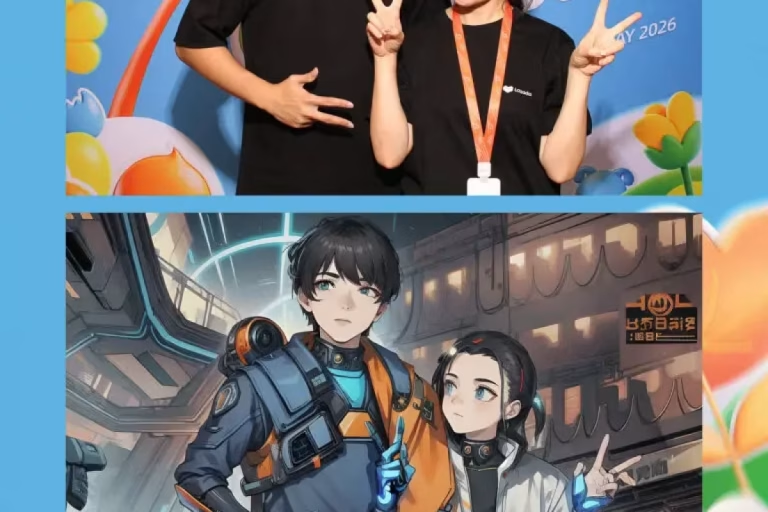
Quick Answer: An AI cartoon photo booth turns a child’s photograph into an illustrated portrait. It works when the child still recognises themselves and the wait is short enough to hold their attention.
An AI cartoon booth is close to a perfect children’s party activity, and it fails in a very specific way that nobody warns you about.
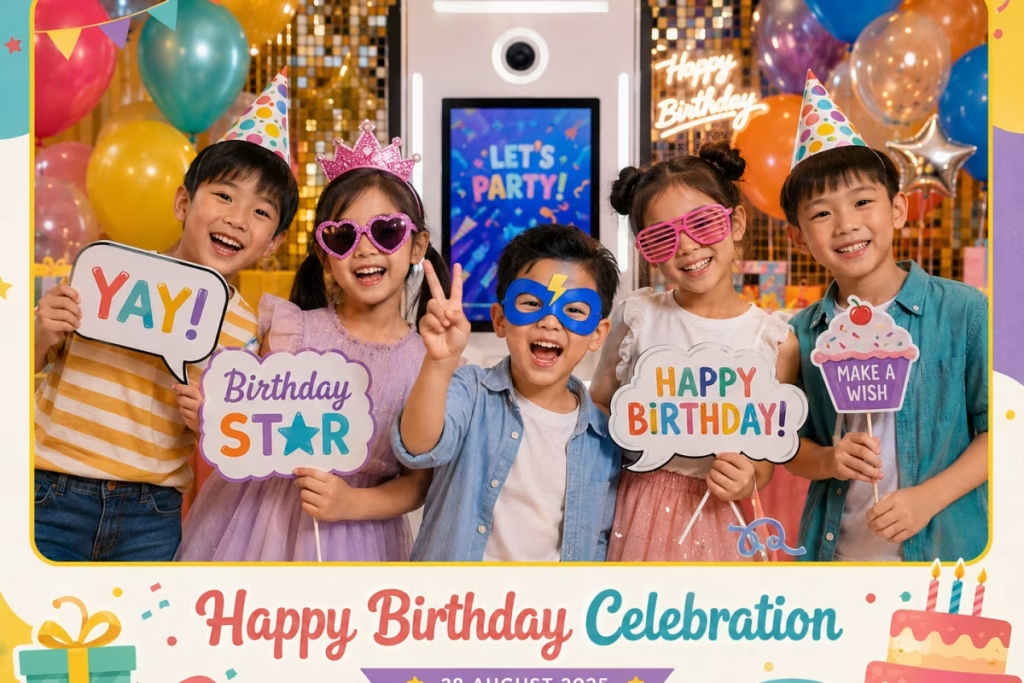
Children are the ideal audience for this format. They are unselfconscious, they love seeing themselves as a character, and the transformation genuinely delights them.
But a young child has a simpler relationship with a picture than an adult does. If it does not look like them, it is not them, and that can be quietly upsetting rather than funny.
The second failure is waiting. A child who has been told something is coming and then waits ninety seconds for it has already left.
This guide covers how to set the styling by age, how to choose a preset that renders quickly, how to handle consent for images of children, and what to do with the result.
Watch: choosing entertainment for a children’s party
A practical discussion of what works as entertainment at children’s parties. The points about attention span and pacing apply directly to running a booth for young guests.
Source: The Balloon Guild
2The child has to recognise themselves
Quick Answer: Young children take a picture literally. If the cartoon does not look like them, they do not experience it as a fun version of themselves, they experience it as somebody else.
This is the whole article in one idea, and it is the opposite of what an adult audience wants.
Adults enjoy a bold transformation because they understand it as a stylised interpretation. They can hold two ideas at once, that it is them and that it is a drawing.
A five year old does not. Shown a picture with a different face shape, different hair and different eyes, they will say plainly that it is not them, and some will be upset by it.
So the strength of the styling should be an age decision rather than a taste decision, and it should be set before the party rather than adjusted after the first child cries.
The practical test is easy. Show a sample to a child of about the age of the guests and ask who it is. If they hesitate, the styling is too strong.
3Matching the style to the age
Quick Answer: Under sevens want a gentle, recognisable cartoon. Older children want a stronger transformation and enjoy choosing it themselves.
| Age group | Style strength | Who chooses |
|---|---|---|
| Under 4 | Very light or none | Parent |
| 4 to 7 | Gentle, clearly recognisable | Attendant suggests |
| 8 to 11 | Strong, themed | The child |
| 12 and over | Anything, including bold | The child |
| Adults at the party | Strong, and they will want a go | Themselves |
Illustrative planning model rather than measured ShutterPop data. Individual children vary considerably.
The last row is not a joke. Parents queue at children’s booths, and budgeting for their sessions is the difference between a smooth afternoon and a bottleneck.
4Choose the fast style, not the best one
Quick Answer: Children will not wait. A style that renders in fifteen seconds beats a more impressive one that takes ninety, because the second one loses the child entirely.
Render time matters more at a children’s party than at any other kind of event.
An adult waiting ninety seconds checks their phone. A six year old waiting ninety seconds wanders off to the bouncy castle and never sees the result.
So the selection criterion is not which style looks best on a laptop screen. It is which acceptable style comes back fastest.
Ask the supplier to time each preset and choose from the fast end. The quality difference is far less noticeable to a child than the waiting is.
The same reasoning applies to the number of choices. Two options presented quickly is better than eight presented on a menu, because choosing is also waiting, a throughput point our guide to AI booth render times works through in general.
5Print it and let them take it home
Quick Answer: A printed cartoon is a party favour that costs almost nothing and gets kept. A digital file goes to a parent’s phone and is never seen again.
Children do not have phones, or at least the ones at a birthday party mostly do not, which changes the delivery question completely.
A digital-only AI booth at a children’s party delivers everything to parents, and the child never actually receives anything.
A print changes that. The child holds it, shows it to other children, takes it home and it goes on a bedroom wall or a fridge.
It also doubles as a party favour, which is a real saving for the host and a far better one than most of the alternatives.
Print generously. Children ask for a second copy for a friend, and the print allowance logic our guide to family events describes applies here too.
Parents will want the digital file as well, and that is easily handled without making it the main delivery. A scan at the booth sends the image to the parent’s phone, and with 99.6 per cent of individuals using a mobile phone in 2025 according to the Department of Statistics Malaysia, that reaches essentially every adult in the room.
Keep the two separate in your head, though. The print is for the child and the file is for the parent, and a booth that only does the second one has missed the guest of honour.
6Consent when the guests are children
Quick Answer: A parent should be present or aware, images of children should not go into a public gallery by default, and the host should know where the files are processed and how long they are kept.
This deserves genuine care rather than a paragraph of reassurance, because the subjects cannot consent for themselves.
Start with presence. A parent or guardian at the booth, or clearly aware that their child is using it, is the baseline and it is easy to arrange at a private party.
Then handle the gallery. A public link containing photographs of identifiable children is not something to set up as a default, and a private link shared with parents does the same job.
Processing is the third question. Many AI booths send images to be processed elsewhere, and Malaysia’s Personal Data Protection Department has issued circulars under the amended framework covering breach notification and data protection officers.
Ask the supplier where images go, how long they are kept and whether they are used for anything else, and get the answer in writing. The consent principles are the same ones our guide to data and consent at events sets out.
7Themes that work
Quick Answer: Broad worlds rather than specific characters. Space, underwater, jungle, superhero and fairytale all work, and generic themes avoid the licensing problem entirely.
Every parent asks for a specific character and it is worth explaining why a broader theme is better.
Named characters belong to somebody, and reproducing them is a rights question rather than a technical one. A generic superhero style is safer and children respond to it just as happily.
Broad worlds also cope better with a mixed group. A party of ten children will not all love the same franchise, but almost all of them enjoy being underwater or in space.
Match the theme to the party’s existing decorations if there are any. The booth then reinforces the party rather than introducing a competing idea.
Where the party has no theme, the safest default is a friendly illustrated style with bright colour, which suits every age in the room and never needs explaining.
One useful refinement is to keep the child’s own clothes in the picture rather than replacing them with a costume. A child in their party outfit, drawn as a cartoon, is far more recognisable to them than the same face on a character’s body.
It also solves an awkward problem quietly. Costume presets tend to be split by gender in ways that suit some children and not others, and keeping the real outfit sidesteps the question entirely.
8Running it so children stay interested
Quick Answer: Lower the camera, keep the queue short, let children watch the render on a visible screen, and put an attendant there who likes children.
The operational side of a children’s booth is different enough to plan separately.
Camera height comes first. A camera set for adults crops a child into the bottom of the frame, so it should be lowered and the frame widened, exactly as at a family day.
Then make the waiting visible. A screen showing the image appearing turns a dead ninety seconds into part of the experience, and children will watch a picture being drawn.
Keep the queue physically short. Children do not queue in a line, they cluster, so a booth with clear space around it works better than one squeezed into a corner.
The attendant matters more than at any other booth. Someone comfortable with children who can get a shy four year old to look at the camera is worth more than any equipment upgrade.
9What to do when a child dislikes theirs
Quick Answer: Offer an immediate retake in a lighter style, and keep a plain printed photograph as a fallback. Never ask a child to accept a picture they are unhappy with.
It will happen at least once at any party, and how it is handled is the difference between a small moment and a memorable upset.
The wrong response is to explain why the picture is good. A child who does not recognise themselves is not going to be argued out of it.
The right response is immediate and cheerful. Try it again with a gentler style, or take a normal photograph and print that instead.
That requires the fallback to exist, which is a booking decision rather than an on-the-day one. Confirm that the booth can print a plain photograph as well as a cartoon.
Tell the attendant this explicitly in the brief. Left to their own judgement, most people try to persuade the child, which is well meant and makes it worse.
10A checklist for the party
Quick Answer: Seven decisions, all made when booking, that cover every problem in this article.
Send this to whoever is arranging the booth.
- Style strength set by age, gentle for under sevens.
- Fastest acceptable preset, with the render timed before the day.
- Two style options offered, not a long menu.
- Printing included, with a generous allowance for second copies.
- A plain photograph fallback available immediately.
- Camera lowered and the frame widened for children.
- Private gallery only, with written answers on processing and retention.
None of these makes the booth more expensive, and together they turn the format from a gamble into the best thing at the party.
Planning a children’s party?
Tell us the ages and how many children are coming and we will set the style, the render time and the print allowance to match — see our kids party booths →
11Conclusion
Quick Answer: Keep the child recognisable, choose a fast style, print the result, keep the gallery private and have a plain photo fallback ready.
The best AI cartoon photo booth ideas for children’s parties are not about the cleverest transformation.
They are about a child seeing a picture that is unmistakably them, in a costume or a world they think is wonderful, quickly enough that they are still standing there when it appears.
Print it so they can carry it around and show everybody, keep the images private, and have a normal photograph ready for the one child who does not like theirs.
For the wider category, see our guide to what AI photo booths do and cost, and for events with a mixed age guest list, our guide to family day booths.
12Frequently asked questions
What is an AI cartoon photo booth?
A booth that photographs a guest and turns the image into an illustrated or cartoon portrait. At a children’s party the result is usually printed as well as delivered digitally, so the child has something to take home.
Are AI cartoon booths suitable for young children?
Yes, with the styling kept light. Under sevens take a picture literally, so a heavily stylised portrait they cannot recognise themselves in can upset them rather than amuse them.
How long do children have to wait for the picture?
It depends entirely on the style chosen, from around fifteen seconds to well over a minute. Choose the fastest acceptable preset, since children lose interest long before adults do.
Can we use a specific cartoon character theme?
Named characters raise rights questions, so a broad theme such as space, underwater, jungle or superhero is safer. Children respond just as well, and a generic world suits a mixed group better than one franchise.
Is it safe to photograph children in an AI booth?
It can be, with care. Keep a parent present or aware, avoid a public gallery by default, and ask the supplier in writing where images are processed, how long they are kept and whether they are used for anything else.
Booking a booth for a children’s party?
Tell us the ages, the number of children and the party theme. We will set the style strength, time the render and make sure everybody goes home holding their picture.