Last updated: 3 September 2026
1Introduction
Quick Answer: Expect a full-length mirror that talks to your guests, photographs them head to toe, and takes longer per group than a print booth. It suits weddings where people have dressed formally and where the booth has more than an hour of real guest time.
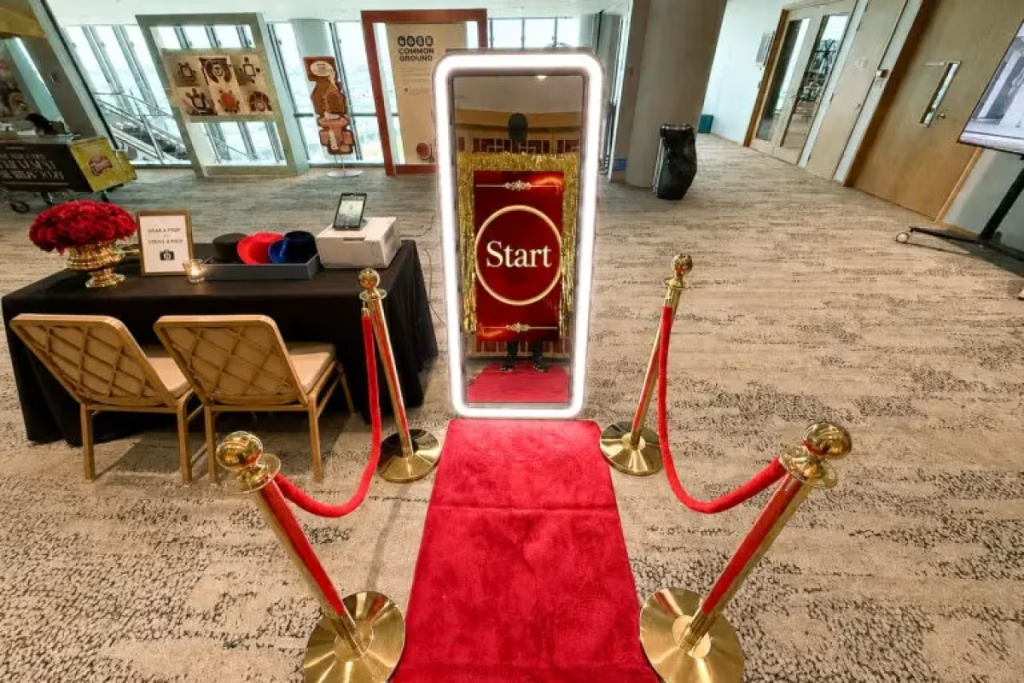
The magic mirror is the booth people recognise from a distance: a tall pane of glass that shows a reflection, then wakes up with animation, a countdown and a prompt to sign the screen.
Most pages describing it list features: touch signature, emoji stamps, voice prompts, custom animations. None of that answers the real question, which is whether this booth fits their night. Two things decide it. The mirror photographs full length, which changes what guests think about. And it works one group at a time at a pace the software sets, which changes how many people get a photo.
With 190,304 marriages registered in Malaysia in 2024, most of them large catered receptions, that second point matters more here than in the imported advice.
Watch: what is behind the glass
A build walkthrough that shows the two-way mirror, the camera and the screen behind it. Seeing how the parts sit together explains most of the questions couples have about how the booth sees them.
Source: Two Way Mirrors
2What the booth actually is
Quick Answer: It is a camera and a touchscreen behind a two-way mirror. Guests see themselves at full height while software runs the session, so there is no shell to climb into and no lens pointed at anyone.
Strip away the styling and a magic mirror is three things in one frame: a two-way mirror, a screen behind it and a camera looking through the glass. When the screen is dark the pane reflects; when it lights up, graphics float on the reflection.
That construction is why the format behaves differently. Guests look at themselves rather than at a lens, so they fix their own posture, adjust a strap, straighten a songkok, and only then trigger the countdown. People pose better in front of a mirror than in front of a camera, and it shows.
Everything after capture is software. Frame overlays, animated prompts, the signature layer, emoji stamps, retakes, print and share. A supplier can change any of it before the event, which matters because the default settings are rarely right for a banquet. Nobody stands there directing: the mirror runs the session and an attendant keeps the queue moving.
3The full-length frame changes everything
Quick Answer: A mirror photographs guests head to toe, so shoes, hems and the floor all appear. It suits weddings where people have dressed properly, and the floor in front of it needs as much attention as the backdrop behind.
A conventional print booth crops around the head and shoulders. A magic mirror shows the whole person, and almost nobody raises that before the event. At a Malaysian wedding it is a real advantage, because a great deal of thought went into outfits that a chest-up crop throws away. A songket, a kebaya, a saree, a tailored suit, the shoes chosen to match: all of it lands in the picture.
It also makes the floor part of the photograph. A busy ballroom carpet, a taped cable run, a box left beside the stand, the edge of a backdrop frame: a print booth would never have shown any of it.
| In the frame | Print booth | What it means for you |
|---|---|---|
| Face and shoulders | Yes | No change |
| Full outfit and hem | No | Formal wear finally shows |
| Shoes | No | Warn guests who plan to kick them off |
| Floor and carpet | No | Busy patterns compete with people |
| Cables and stands | No | Dress the base or lay a rug |
| Backdrop bottom edge | No | Backdrop must reach the floor |
Illustrative planning model for typical booth framings. Exact coverage varies with the print template and how many guests are in shot.
Backdrop advice written for shell booths does not transfer, because a short panel that works at head height leaves a gap at the bottom. Our guide to backdrops that photograph well covers the material side; for a mirror, add height and a clean floor.
4The signature screen is the bottleneck
Quick Answer: The touch-signature step is the feature everyone buys the mirror for and the one that halves its throughput. On a short reception window, ask for it to be switched off or made optional.
Every extra interactive step adds seconds, and seconds decide how many guests get a photo.
| Step | Roughly | Can it be trimmed? |
|---|---|---|
| Group gathers and arranges | 20 to 40 s | Only with an attendant |
| Intro animation and prompt | 5 to 10 s | Yes, shorten it |
| Countdown and shots | 20 to 30 s | Fewer frames per session |
| Review and retake | 0 to 30 s | Yes, limit to one retake |
| Signature and stamps | 30 to 90 s | Yes, and it is the big one |
| Print and collect | 15 to 25 s | Overlaps the next group |
Illustrative planning model, not measured ShutterPop timings. Real sessions vary with group size, guest age and how the software is configured.
Take the middle of those ranges and a session with signing runs about two and a half minutes. Turn signing off and it falls under ninety seconds: over a ninety-minute window, roughly thirty-five groups instead of sixty.
Neither number is wrong. A garden lunch with eighty guests absorbs the signing happily, and the signed prints make a lovely album. A four-hundred-guest banquet with an hour of movement cannot, and the honest advice there is to switch signing off and let the queue flow.
5Where it beats a print booth, and where it does not
Quick Answer: The mirror wins on outfits, on large groups and on older guests who dislike enclosed booths. A shell print booth wins on speed, on tight corners and on very bright rooms.
Both formats print, both share digitally, both cost roughly the same. The differences are in behaviour.
| Aspect | Magic mirror | Shell print booth |
|---|---|---|
| Framing | Full length | Head and shoulders |
| Comfortable group size | Six to ten | Three to six |
| Sessions per hour | Lower | Higher |
| Older or shy guests | Easy, nothing to enter | Some avoid the enclosure |
| Bright or sunlit rooms | Reflections are a risk | Largely unaffected |
| Floor preparation | Needed | Not needed |
Illustrative behaviour comparison across common booth formats rather than a test of specific machines.
Read the group-size row twice. Colleagues and relatives arrive as a table of ten wanting one photo together, and a full-length frame holds that group where a shell booth splits it into two batches.
If you are weighing the two directly, our comparison of magic mirror and instant print booths goes further into the trade-off.
6Reflections: the problem unique to a mirror
Quick Answer: A mirror reflects whatever faces it. Position it away from windows, spotlights and the LED wall, or guests will struggle to see the screen and the glass will show the room behind them.
The glass is the format’s charm and its one weakness. It reflects the room, so what sits opposite the mirror matters as much as what stands behind the guests.
Three sources cause almost all the trouble at Malaysian venues. Afternoon sun through a function-room window, which washes the screen out entirely, and in the year-round bright conditions described by the Malaysian Meteorological Department that applies to almost every daytime event. A ceiling spotlight above the mirror, which puts a bright disc across the glass. And the LED wall now standard at banquet halls, which throws shifting colour onto everything facing it.
All three are cheaper to solve at setup than to fix later. Angle the mirror away from the light source, ask the venue to switch off the two spots directly above it, or move the station a couple of metres. Raise it at the site visit: a photograph of the corner you have in mind usually gets an answer in a minute.
7Space, floor and power at the venue
Quick Answer: A mirror needs more depth than a shell booth because it frames guests head to toe, plus a level floor, a nearby socket and a queue area that does not block a service route.
Depth is the dimension venues forget. To fit eight people head to toe the camera sits further back, so a corner that comfortably held a shell booth may not hold a mirror at all.
Floor level matters too. A mirror is tall and stands on a base or wheeled stand, so a sloping lawn or a ramp edge becomes a stability question. Ballroom carpet is fine; grass and paving need a board underneath.
Power is ordinary: a standard socket within a reasonable cable run, on a circuit not shared with the kitchen or the band. Agree the run in advance so the cable is taped along a wall rather than across the guest route, which is a trip hazard and, in a full-length frame, visible in every photo.
The full clearances sit in our guide to photo booth space requirements. Take them to the venue coordinator early: the good corners go to the cake table first.
8Prints, sharing and what guests take home
Quick Answer: Guests leave with a print in hand and a digital copy on their phone. Confirm print size, whether every person in a group gets a copy, and how the digital delivery works before the day.
A full-length photograph needs a taller print format than a shell booth’s classic strip, so ask to see the template. A vertical 4R suits the framing; a narrow strip crops a full-length shot awkwardly.
The bigger question is copies. A table of ten photographs together and one print appears. Some packages print one per session, some one per person, and at a large wedding the difference is hundreds of prints. Get it into the quotation.
Digital delivery does the rest of the work. Department of Statistics Malaysia figures from the ICT Use and Access Survey 2025, released on 23 April 2026, put mobile phone use by individuals at 99.6 percent and internet use at 98.3 percent, so effectively every guest can receive a copy within minutes by QR code or WhatsApp. The print goes onto a fridge door; the digital copy is the one shared the same night, reaching people who were not there.
9Styling it so it belongs to your wedding
Quick Answer: The print overlay, the on-screen prompts and the frame surround are the three things worth customising. Names across the middle of the backdrop are not, because a group of eight will stand in front of them.
The decorative surround is the most visible piece of styling at the station, because guests look straight at it while they wait. Matching it to your palette costs nothing and does more than an extra metre of flowers.
The print overlay is where your names and date belong. It appears on every photograph, it is never obscured, and the template is being designed anyway. Wording on the backdrop behind guests spends the night hidden behind shoulders.
On-screen prompts are the quiet win. The default is usually English, and a line of Malay or Chinese on the welcome screen changes how the older half of the room approaches the booth. Most suppliers can set the wording; ask.
Keep the animation restrained, because heavy filters date quickly and these photographs are meant to be looked at in five years. The styling ideas in our wedding photo booth guide apply to the mirror unchanged.
10What to confirm before you sign
Quick Answer: Confirm the hours, whether setup sits inside them, prints per session, the attendant, the signature setting and the printer backup plan. The rest can be decided later.
Booking a mirror is a short conversation if you ask six questions.
- Which hours are booth hours. Setup and teardown sit outside the paid window, not inside it.
- Prints per session. One per group or one per guest, in writing.
- Attendant on site. Somebody has to keep the queue moving and reload paper.
- Signature on or off. Your call, made against your window length.
- If the printer fails. A spare unit, or capture that continues and prints later.
- Idle hours. Whether a gap between ceremony and reception is charged.
Timing is the other half. Popular dates go early and the good suppliers are booked out first; our photo booth booking timeline sets out when to lock each decision.
Not sure a mirror fits your venue?
Send us your hall, your guest count and your reception timing, and we will tell you whether the mirror or a print booth will serve more of your guests — see our magic mirror photo booth →
11Conclusion
Quick Answer: Book a magic mirror when your guests have dressed for the occasion, your groups are large and your booth window is generous. Book a print booth when the window is tight and the corner is small.
A magic mirror photo booth wedding station earns its place for one reason, and it is not the animation. It photographs people at full height, in the clothes they spent months choosing, in groups big enough to hold a whole table.
What you pay for that is pace. The mirror is a slower device by design, and the signature screen makes it slower still, so the honest planning question is whether your reception has the time to spend. Malaysian weddings run to a tight programme, and the number of guests who reach the booth is set by minutes rather than intentions.
Still weighing formats? Start with our wedding photo booth ideas, then tell us your venue at ShutterPop.
12Frequently asked questions
How many people fit in a magic mirror photo booth shot?
Six to ten stand comfortably in a full-length frame, which is more than a shell booth holds. Larger groups work if the mirror has enough depth in front of it, so check the space before promising a table of twelve one photograph.
Does a magic mirror booth print photos on the spot?
Yes. Prints come out within about twenty seconds of the session ending, and most setups also send a digital copy by QR code or link. Confirm whether the package prints one copy per session or one for every guest in the shot.
How long does each magic mirror session take?
Around ninety seconds without the signature step and up to two and a half minutes with it. That difference decides how many guests get a photograph, so match the setting to how long your booth window really is.
Can guests sign or draw on the photos?
Yes, that is the signature feature, and it is the reason many couples choose the mirror. It adds meaningful time per group, so it suits longer or smaller events better than a packed banquet with a short movement window.
Does a magic mirror booth work outdoors in Malaysia?
It can, on a level surface, under cover, and away from direct sun. Bright daylight reflects off the glass and makes the screen hard to see, and any evening setup needs a light aimed at the guests rather than at the mirror.
Want the mirror at your wedding, set up properly?
Tell us your venue, date and guest count. We will recommend the right settings for your programme and, from our 40+ booth formats, the pairing that reaches the most guests.